
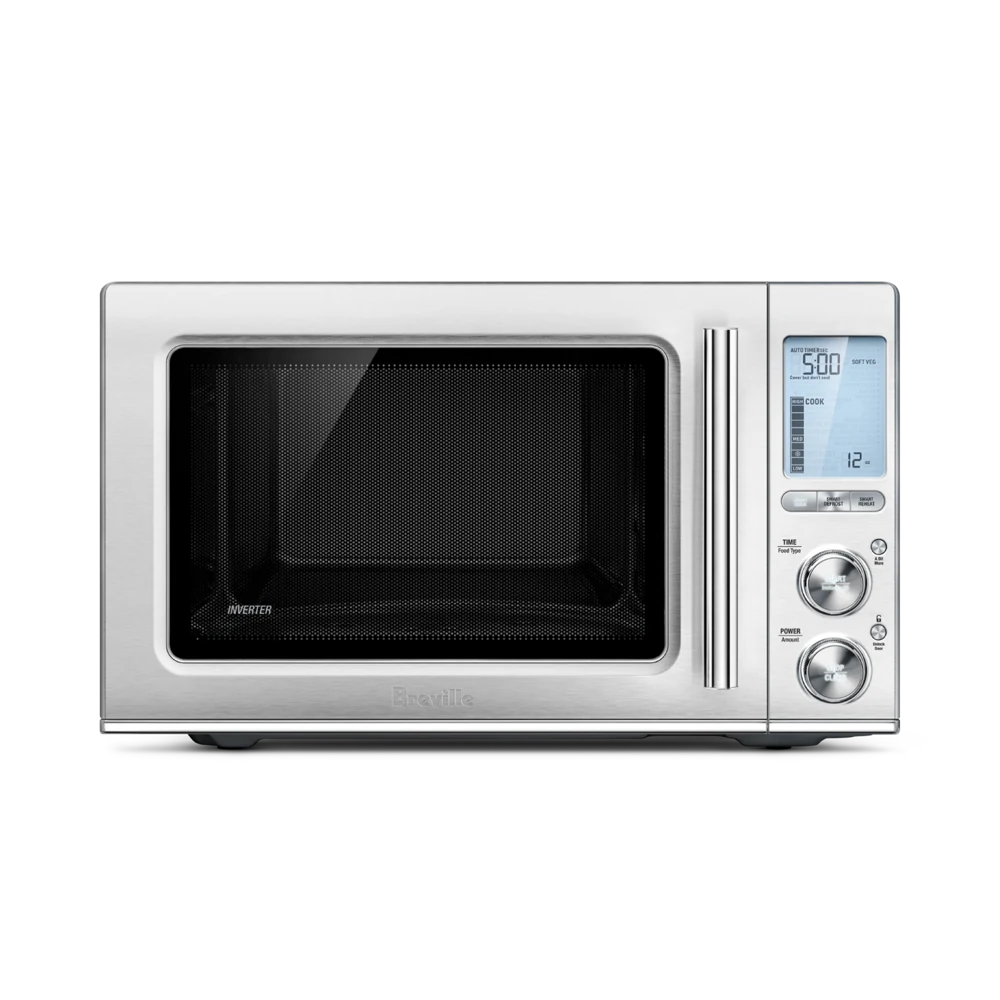
Your needs, this model
Does it fit your priorities?
Will it sense steam rather than just ask for a portion?
The current US manual explicitly describes Smart Reheat detecting steam released by food. Follow its instructions and check the meal; not every Smart Cook selection uses the same method.
Explore this need in the finder →Does it suit someone who prefers dials and fewer beeps?
It has time and power/amount dials plus documented mute and sound-volume controls. Muting alerts does not silence the fan, motor or physical door.
Explore this need in the finder →Why choose this instead of the Combi Wave?
Choose it for sensor-assisted microwave reheating when you do not need extra hot-air or grill functions. The separate Combi Wave adds those cooking methods, accessories and installation needs.
Explore this need in the finder →The Breville Smooth Wave BMO850BSS1BUC1 is worth considering when you want sensor reheating, inverter power control and dial-led operation in a conventional microwave. Its attraction is a more considered everyday interaction, including sound controls and soft closing. Choose the Combi Wave instead only if you actually need its additional hot-air and grill functions.
Why this differs from a basic reheating box
Breville's US product page explicitly identifies Sensor iQ and Power Smoothing Inverter for the Smooth Wave. The first helps with automatic cooking and reheating; the second concerns microwave power delivery. These are useful differences for a person whose portions and foods change, rather than someone who always wants the same full-power thirty seconds. Breville Smooth Wave US model page.
The sensor is not a replacement for checking the meal. A mixed plate with dense ingredients poses a different problem from a shallow uniform portion. Use the relevant food instructions, give sensing the conditions it needs and check the result. A premium interface cannot make an unsuitable container or a tightly piled meal behave as though it were prepared correctly.
Dials are a preference you can evaluate directly
The design uses separate adjustments for time and power or amount, with dedicated cooking and reheating functions. Someone who likes turning a control may appreciate that approach more than entering digits on a keypad. Someone used to typing a precise time should inspect the sequence before assuming that more expensive controls will be easier.
Consider an ordinary evening use: open, put a bowl inside, select a function or time, start and add a little more if necessary. The shortcut panel inside the door keeps additional functions available without putting every option on the main front. That arrangement can be appealing, but it also means a closed-door photograph is not the whole interface.
Sound controls and soft closing address separate annoyances
Breville describes mute and sound options for the Smooth Wave, as well as a soft-close door. Muting addresses electronic alerts. Soft closing addresses the door returning to its closed position. Neither should be converted into a promise that you will never hear the fan, motor or an appliance running in a neighboring room. Breville's own Smooth Wave feature description.
The brand's quieter-operation comparisons have specified comparison conditions. They are not a universal ranking against every microwave you could buy today. If your main concern is waking someone, identify whether the irritating sound is a beep, the door or the whole running cycle. Different requirements can produce a different shortlist.
Useful cavity size without combination-oven hardware
Breville's product comparison identifies the Smooth Wave as a 1.2-cu.-ft., 1,200-watt microwave. That is cooking output, not a promise that every recipe takes a particular time. The input figure on the rating label is a separate electrical consideration. Breville-authored model comparison.
For a regular plate or bowl, check the actual dish outline, lid and handles. More nominal volume than a compact model does not prove that a tall container or square casserole will fit through the door and rotate. If the dish you own is the reason for upgrading, use it as the practical test rather than choosing by capacity alone.
Open-counter space is part of the decision
The reviewed current US manual lists a body 20.4 inches wide, 17.5 deep including its handle, and 12.5 high. The product page rounds height differently, so use the supplied edition's instructions and actual measurements for a restricted installation. Leave room for the plug and taking a hot dish out, as well as the specified ventilation.
The reviewed placement directions require four inches to adjacent walls and eight inches above and prohibit cabinet placement. A neat-looking enclosure is therefore not an approved shortcut to a built-in appearance. The useful footprint is the appliance in a safe working position, not merely its metal casing. Breville's currently linked US instruction book.
Check the physical door edition
Breville's later instructions include a separate Door Unlock control, while earlier Smooth Wave panels differ. A control child lock and a door-access lock do different jobs. Soft close says how the door closes; it does not establish that opening is a single action on every offered unit.
If grip or one-handed operation matters, inspect the actual panel and its supplied instructions. Use the manufacturer's options for that edition rather than an unlock sequence from another Breville. The full BMO850BSS1BUC1 US identity should remain attached to the offer; a regional suffix should not be discarded simply because the brand and main number match.
Where it belongs in your questionnaire results
The Smooth Wave should come forward for sensor and inverter preferences, regular portions, a dial-led interface and documented mute. It should fall back when the central requirement is a very small body, cabinet installation or actual baking and air frying.
Those extra cooking methods belong to a different product decision. If all you need is comfortable reheating and defrosting, a solo microwave with the right controls can be a better fit than a combination oven with accessories you will rarely use. Check the exact unit and return terms, then choose the interaction and installation that improve your everyday kitchen.
Key details at a glance
| Nominal cavity | 1.2 cu. ft. |
|---|---|
| Cooking output | 1200 W |
| Turntable diameter | 12.4 in |
| Sensor reheating | Documented |
| Inverter power control | Documented |
| Alert mute setting | Documented |
| Approved trim-kit route | Not supported in reviewed instructions |
| Body W × D × H | 20.4 × 17.5 × 12.5 in; ventilation additional |
Facts apply to the reviewed model and document edition. Read the relevant section for generation differences and installation conditions.
Sources for this assessment
Compare it with your other choices
Use your needs to find alternatives and understand the tradeoffs.