
Your needs, this model
Does it fit your priorities?
Does it offer real air frying and oven cooking?
The current US instructions document Airfry, Oven, Grill, Microwave and Fast Combi. Choose it for meals that use those heat sources, with the correct accessories and handling.
Explore this need in the finder →Is Smart Reheat the same as the Smooth Wave’s steam sensor?
That is not established. The current Combi Wave instructions use selected quantities or time; we do not transfer the Smooth Wave’s Sensor iQ steam-detection claim to it.
Explore this need in the finder →Can I use the smaller Breville’s ventilation footprint?
No. This reviewed US manual requires eight inches to adjacent walls and twelve inches above, on an open counter. The body is 20.2 inches deep including the handle, before the rear ventilation gap.
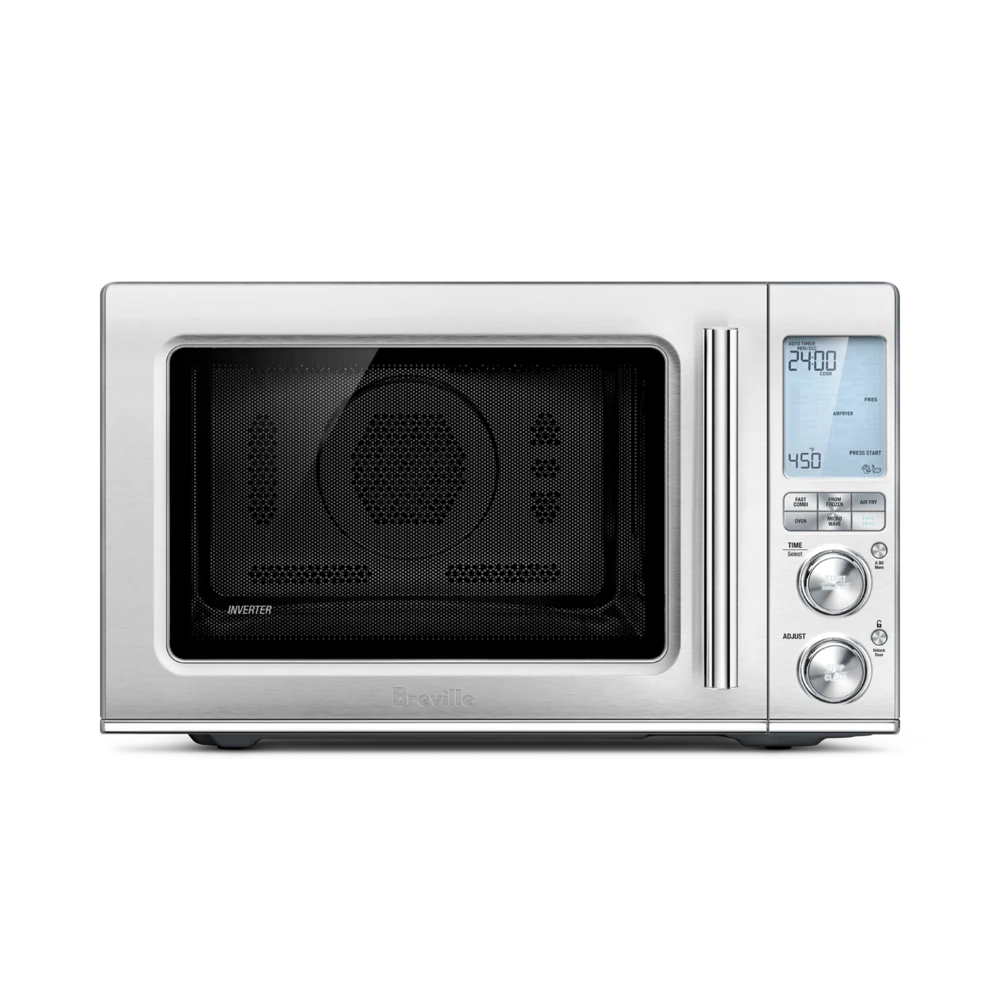
Explore this need in the finder →The Breville Combi Wave BMO870BSS1BUC1 is a genuine combination appliance: inverter microwave, convection oven, air fryer and grill functions share one countertop position. It is most compelling when your meals need both reheating and browning. Its tradeoffs are depth, mode-specific handling and a more involved interface than a simple number-pad microwave.
Choose it for a second cooking job you will use
Breville documents microwave, oven, air-fry and grill functions, plus Fast Combi and Cook from Frozen programs. That establishes actual additional heat sources, rather than calling an ordinary microwave preset an air fryer. Write down the foods you want those extra functions to prepare before choosing the appliance. Breville Combi Wave US page.
A small baked dish and reheated soup can make sense in a shared appliance. A large family load of frozen snacks may require batches. If you need to microwave a side dish while the oven component is occupied, one machine cannot provide two independent cooking spaces. Consolidating counter positions is useful only when the resulting schedule suits the meal.
Its accessories are part of the cooking system
The maker lists a Combi Crisp pan and trivet. They are specific accessories for specific jobs, not permission to put arbitrary metal cookware into microwave or combination operation. Follow the actual instruction book's mode and accessory guidance, including when food needs an oven-safe or microwave-safe container.
This is especially important in a shared kitchen. The next user should not press a microwave shortcut without realizing that the previous meal left a different setup inside. Have a safe storage and cooling place for accessories, and make switching modes a deliberate step. A single multifunction appliance can require more handling than two simpler dedicated machines.
Inverter reheating remains a separate benefit
Breville explicitly describes Power Smoothing Inverter for the microwave function. That is relevant to a preference for controlled reduced-power reheating or defrosting. It does not eliminate the need to follow portion instructions or check the center of a thick meal.
The current US manual's Smart Reheat instructions use selected quantities or time; they do not establish the Smooth Wave's steam-detecting Sensor iQ operation for this model. We therefore do not count the Combi Wave as an essential humidity-sensor match. When reheating is your main job, compare the actual program instructions rather than judge the oven by its smart label.
Different wattages describe different heat sources
Breville's US material separates microwave, grill and convection ratings. Its model comparison gives 1,100 watts of microwave cooking output. The US product page separately lists electrical input by mode; these numbers should not be merged into a single microwave-power claim. Breville-authored comparison chart.
Use cooking output to interpret microwave food directions. Use the actual unit's label and installation manual for the electrical supply. A combination program may apply several heating methods at different stages; it should not be treated as a simple arithmetic addition of the largest figures in a specification list.
Dial-led controls reward a little learning
The front has function buttons and rotary adjustments, with additional shortcuts inside the door. That arrangement can suit someone who prefers turning a dial to repeated number entry. It can also take more practice when you are choosing among power, temperature, weight and time.
Learn one normal microwave task and one hot-air task before exploring combinations. Know how to pause, clear a mistaken selection and add a little time. The goal is not to use every available program; it is to perform the meals you actually cook confidently without guessing which value you are changing.
Door and sound conveniences need precise expectations
Breville identifies a soft-close door, mute and sound controls. Those are useful design features for someone who dislikes abrupt electronic alerts or door closing. Manufacturer noise comparisons are tied to specific test conditions and do not make the whole appliance silent.
Later US instructions include a separate Door Unlock control; earlier panels differ. Check the actual opening action if grip, reach or one-handed use is important. The physical door arrangement is distinct from the control-panel child lock, and soft closing does not answer how the door opens.
Depth is the obvious installation compromise
The current US manual specifies a 1.1-cu.-ft. cavity and body 20.4 inches wide, 20.2 deep including the handle, and 12.5 high. It requires eight inches to adjacent walls and twelve inches above. Those gaps are larger than the Smooth Wave's, so do not borrow the smaller model's installation footprint.
Leave a suitable landing surface nearby. After oven cooking, the cavity and pan can be hot even when the next task is ordinary microwave reheating. This is an open-counter appliance, and the reviewed manual does not authorize enclosing it in a cabinet merely because a shelf accommodates the body. Currently linked US Combi Wave instruction book.
Who should put it on the shortlist?
Choose this direction when you want microwave plus browning or oven cooking, prefer dials, have adequate working space and are willing to handle mode-specific accessories. Prefer a simpler microwave when almost every job is a drink or short leftover reheat.
Keep the complete US model and actual edition attached to the purchase. The best reason to choose the Combi Wave is a realistic set of meals that uses its different heat sources, with enough room and time to use them comfortably. Versatility is valuable when it simplifies your kitchen routine, rather than merely expanding the list of buttons.
Key details at a glance
| Nominal cavity | 1.1 cu. ft. |
|---|---|
| Cooking output | 1100 W |
| Turntable diameter | 12.4 in |
| Inverter power control | Documented |
| Alert mute setting | Documented |
| Approved trim-kit route | Not supported in reviewed instructions |
| Body W × D × H | 20.4 × 20.2 × 12.5 in; ventilation additional |
Facts apply to the reviewed model and document edition. Read the relevant section for generation differences and installation conditions.
Sources for this assessment
Compare it with your other choices
Use your needs to find alternatives and understand the tradeoffs.