
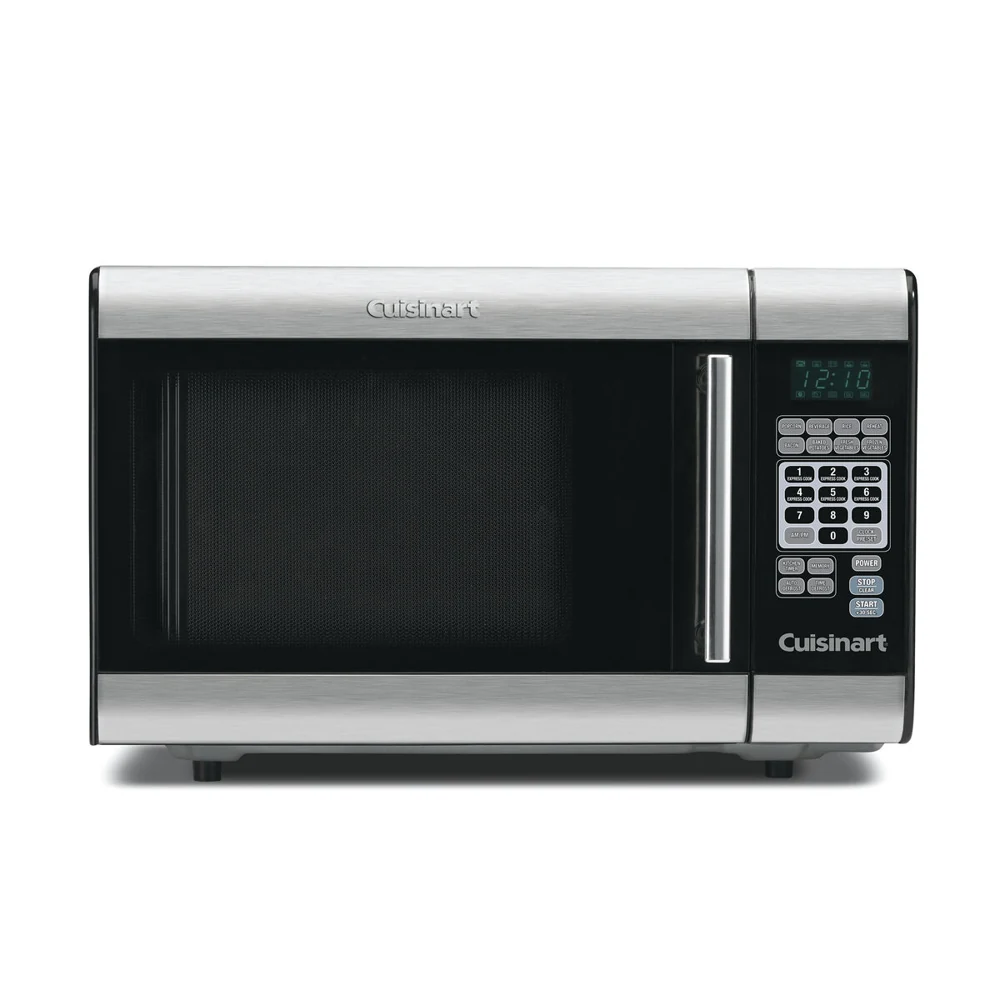
Your needs, this model
Does it fit your priorities?
Does Auto Menu mean sensor reheating?
No. The reviewed CMW-100 material documents presets but does not establish humidity sensing. The separate CMW-110 has explicit sensor and inverter evidence.
Explore this need in the finder →Can I plan a tight shelf from its published dimensions?
The maker page and booklet disagree on the exterior dimensions. Obtain measurements of the exact unit and follow the open-side and twelve-inch overhead requirements before choosing a position.
Explore this need in the finder →Why consider a discontinued model?
It may suit a specific offer or familiar replacement with keypad timing and staged cooking. Check condition, original tray and returns; the archived page does not verify an individual seller’s unit.
Explore this need in the finder →The Cuisinart CMW-100 is an earlier countertop microwave worth understanding if you are comparing a specific offer or replacing one you know. Its main attractions are familiar number-key controls, a stainless interior and programmable cooking stages. It is not our confirmed choice for humidity-sensor reheating, inverter control or a close-fitting cabinet installation.
Why this older model can still be relevant
Cuisinart identifies the CMW-100 as discontinued. That describes its place in the manufacturer's range, not the condition or availability of every seller's unit. If an offer interests you, the important questions are the exact model, return protection and whether the original tray and accessories are included. An earlier design can still suit a familiar routine, but age is not a reason to overlook condition. Cuisinart's archived model page.
Someone already comfortable with a number pad may prefer its direct timing approach to an unfamiliar dial or layered touchscreen. That preference should be assessed alongside the actual panel layout. Look at how you choose a lower power level, add time and cancel an incorrect entry. Those small tasks matter more than an impressive count of preset combinations if you repeat them every day.
What the cavity means for your usual meal
The maker describes a 1.0-cu.-ft. microwave with 1,000-watt cooking output. The manual gives a 28-liter cavity and a 12.4-inch turntable, while the archived product text rounds the tray to twelve inches. Use the original part and verify dish rotation rather than treating either rounded number as a guaranteed maximum plate size. Cuisinart instruction booklet.
A regular plate, a bowl and a handled storage container place different demands on the opening. For a replacement purchase, measure the dish that matters most and compare it to the actual oven. Nominal cavity volume does not tell you whether a tall lid or rectangular handle will clear. Check that you can remove the dish safely with the oven off before relying on it for a hot meal.
Stainless steel is a cleaning preference, not a performance score
Cuisinart documents a stainless interior, stainless door accents and a pull handle. For someone who likes wiping an exposed metal cavity, that is a legitimate design preference. It does not establish superior heating uniformity or permission to use abrasive cleaners. Food residue still needs regular removal in accordance with the manual.
The current archived page's finish selector and descriptive copy are not completely consistent. Do not order an earlier microwave on the assumption that a generic color field proves the exact finish you will receive. Ask for a clear photograph and model label when appearance matters, especially with used, refurbished or old-stock offers.
Stage cooking helps repeat a known procedure
The booklet covers ten power levels, number-key timing, time and weight defrost, memory and two-stage cooking. A saved procedure can be useful for a consistent portion: first thaw an ingredient, then apply a different cooking stage. It is less useful when the amount and starting temperature change every day.
It is worth learning one repeatable meal rather than trying every automatic category immediately. Note the container and portion that work for you, then check carefully when either changes. A preset is a starting method, not a food thermometer. If the meal needs stirring or standing, saved timing should leave room for that handling rather than encourage you to walk away.
Auto menus do not establish a humidity sensor
The archived model page advertises preset programs, but the reviewed exact material does not establish sensor-reheat or inverter operation. Those missing confirmations matter if your questionnaire makes either feature essential. The CMW-110 is a separate Cuisinart model with explicitly documented sensor and inverter functions; its specification cannot be transferred backward to the CMW-100.
Someone who prefers manual timing may not miss those features at all. If you usually heat the same lunch bowl and check it after a short interval, a familiar interface can be more important than automation. If portion variation is the reason you are replacing your microwave, look for a model with the specific automatic system you want.
Do not use conflicting dimensions to approve a tight fit
The archived product page and booklet give incompatible exterior dimensions, and the booklet's printed axis labels are awkward. This is not a model we can confidently recommend against a strict width, depth or height limit from those numbers alone. Measure the offered unit or obtain confirmation from Cuisinart for that exact edition.
The placement instructions are clearer: open countertop use, three inches to adjacent walls, one side open and twelve inches above. A cabinet that fits the body is therefore not enough. The manual separately lists 1,450-watt input and 1,000-watt output; electrical planning must use the label and installation instructions, not the cooking number alone.
When it matches your questionnaire
Keep the CMW-100 on an earlier-model shortlist for straightforward keypad timing, documented stainless interior and familiar multi-stage routines. It should not be selected for essential sensor, inverter, mute or an exact enclosed fit without stronger model-specific evidence.
If a seller's offer is the starting point, verify the whole CMW-100 identity, condition, tray and return terms. The useful question is whether this particular design still solves your everyday meal problem. A discontinued label need not end the comparison, but it does make exact identification and safe installation especially important.
Key details at a glance
| Nominal cavity | 1.0 cu. ft. |
|---|---|
| Cooking output | 1000 W |
| Turntable diameter | 12.4 in |
Facts apply to the reviewed model and document edition. Read the relevant section for generation differences and installation conditions.
Sources for this assessment
Compare it with your other choices
Use your needs to find alternatives and understand the tradeoffs.