
Your needs, this model
Does it fit your priorities?
Does it suit a small kitchen and one lunch bowl?
It is a relevant starting point when your usual container fits the 10.75-inch tray and door opening. The small body still needs the documented side, top and rear gaps, plus room to open and handle a hot dish.
Explore this need in the finder →Can I reheat food without the usual alert beeps?
The dedicated Sound control provides mute or normal operation. That helps with electronic alerts; it does not silence the fan, turntable or door.
Explore this need in the finder →Will the door open like my older microwave?
The reviewed newer edition uses a two-step child-resistant door routine. Check the actual controls and opening action, especially if a familiar single-action release is important to you.
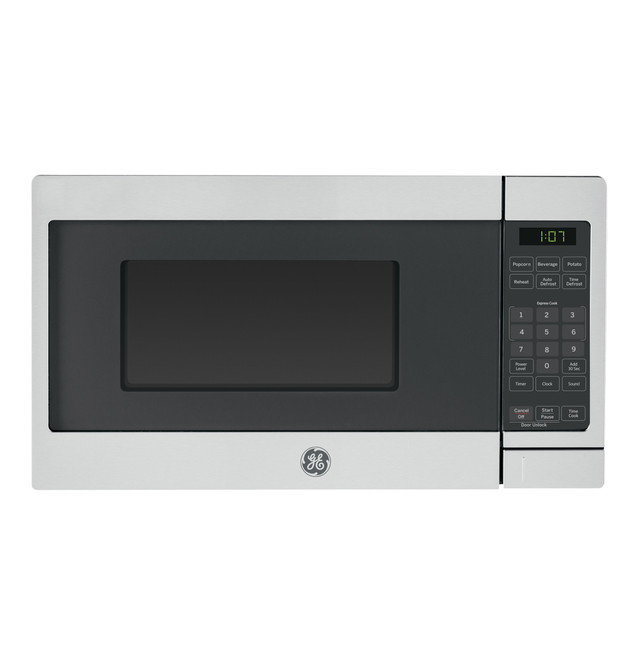
Explore this need in the finder →The GE GCST07N1WSS is worth considering when a small open counter, modest serving dishes and familiar number-pad controls matter more than a roomy cavity. Its 0.7-cubic-foot capacity and 700-watt output define that compact role. A dedicated Sound button can mute the beeper, while the newer two-step door lock changes how you interrupt cooking. Check the space around it and the dishes you actually use before choosing it for those conveniences.
This review concerns the US stainless GCST07N1WSS, using GE's exact model support page, specifications and November 2024 owner's manual. The assessment focuses on documented functions and their practical fit for a home kitchen.
A small body still needs breathing room
GE's Quick Specs gives the body as 17.3125 inches wide, 12.75 deep and 10.1875 high, including the feet in its height. Those numbers are useful for a first counter check. They are not the complete space it needs while operating.
The countertop clearance guidance, consistent with this model's manual, calls for three inches on each side and above, plus one inch behind. Body width plus those side gaps is 23.3125 inches. The front door surface must also sit at least three inches back from the counter edge. Keep that setback in mind on a shallow worktop, alongside the cord and room to stand with a hot dish.
This is a countertop choice. The shared manual's hanging-kit entry names GCHK07N1, a different model; it does not authorize suspending this GCST model under a cabinet. A snug appliance cubby therefore needs a different installation decision, even if its opening accepts the closed body.
Measure the dinner plate, including its cover
The exact model specifications list a 10.75-inch glass turntable and a cavity 12.25 inches wide, 11.625 deep and 7.875 high. These describe different boundaries. The tray supports the dish; the cavity surrounds it. Neither measurement establishes that a particular handled container can pass comfortably through the door and rotate without touching.
For a bowl of leftovers or a small plate, compare the complete container with those dimensions. For a large dinner plate, take its diameter to the seller and request a fit check on this exact model. Include the usual cover, handles and gripping room. A container that squeezes inside but cannot be removed securely is a poor everyday match. GE also lists 25.625 inches of depth with the door open 90 degrees, which matters when an opposing wall or walkway limits access.
Simple reheating has two useful routes
The number keys 1–6 start equal minutes of Express Cook. Add 30 Sec starts a short session or extends one already running. These controls suit someone who repeats a familiar snack or adds a little more time after checking lunch. For a specific interval, Time Cook provides ordinary number entry followed by Start.
Popcorn, Beverage, Potato and Reheat provide additional shortcuts. Reheat asks for a food category, with serving choices where applicable. That still leaves decisions for the person loading it: a mixed plate and a single type of leftover are different jobs. Buyers seeking steam-sensor reheating should require explicit confirmation of that feature rather than treating a Reheat label as proof. For irregular meals, learning one time-and-power routine may be easier than remembering several preset paths.
Plan around 700 watts and your normal portions
The 700-watt figure describes cooking output. GE separately rates the electrical input at 1,050 watts on 120 V, 60 Hz. Use the cooking figure when checking food-package directions; the larger electrical number does not turn this into a 1,050-watt cooking appliance. Follow any lower-wattage guidance supplied with the food instead of expecting a higher-power microwave's stated time to transfer unchanged.
The adjustable power settings give you another way to approach reheating. The manual describes lower settings as periods of microwave energy alternating with rests. That can be useful when a full-power routine is too aggressive, but it does not establish a measured advantage in heating uniformity. Consider your workload: heating one modest portion and heating several meals in succession place different demands on a compact oven. If the latter is your daily routine, available dish room and acceptable waiting time deserve as much weight as the small exterior.
Mute the alerts, then judge the remaining sound
The owner's manual, page 12, explicitly gives Sound a mute or normal choice. That is a meaningful convenience for someone heating food near a sleeping household or a shared work area. It does not promise a silent cooking session: the appliance still operates, and the manual discusses blower changes and a dull operating thump. If mechanical sound is decisive, listen to a demonstration rather than relying on the beeper setting or an unsupported decibel comparison.
The door lock changes the stirring routine
The child-resistant door feature locks when cooking starts. To reach inside during a session, first press Start/Pause or Cancel/Off, then press the front door-release button. Start/Pause is the useful choice when you intend to stir and resume the same session. This extra action deserves attention if you are replacing an older microwave whose release button opened the door directly.
GE documents an optional door-lock setting on page 12 of the model's manual. The separate keypad lock serves a different purpose; use the instructions for the specific function you intend to change. Anyone concerned about reach, grip or remembering the sequence should try the actual controls before buying, with the microwave at the intended height.
The strongest fit is a household whose normal dishes pass the fit check and whose counter can preserve the specified gaps. Simple timed reheating and muted alerts then become practical benefits. Larger serving ware, an enclosed installation or a need for effortless single-action door access changes that assessment more than the stainless finish does.
Key details at a glance
| Nominal cavity | 0.7 cu. ft. |
|---|---|
| Cooking output | 700 W |
| Turntable diameter | 10.75 in |
| Alert mute setting | Documented |
| Body W × D × H | 17.3125 × 12.75 × 10.1875 in; ventilation additional |
Facts apply to the reviewed model and document edition. Read the relevant section for generation differences and installation conditions.
Sources for this assessment
Compare it with your other choices
Use your needs to find alternatives and understand the tradeoffs.