
Your needs, this model
Does it fit your priorities?
Can one position serve microwaving and small crisping or oven tasks?
The documented convection, broil, combination and air-fry modes make that possible. Check your regular portion, the supplied pan and rack arrangement, and suitable cookware for each mode.
Explore this need in the finder →Does 1.0-cu.-ft. capacity tell me how many fries I can air fry?
No. Air-fry portions depend on usable pan surface and airflow, not cavity volume alone. Consider whether your usual serving would require several batches before replacing another appliance.
Explore this need in the finder →Should I choose it specifically for automatic sensor reheating?
That exact function has not been established: the manual’s generic sensor paragraph and portion-based Reheat instructions do not provide a consistent specific match. Choose documented sensor evidence when it is essential.
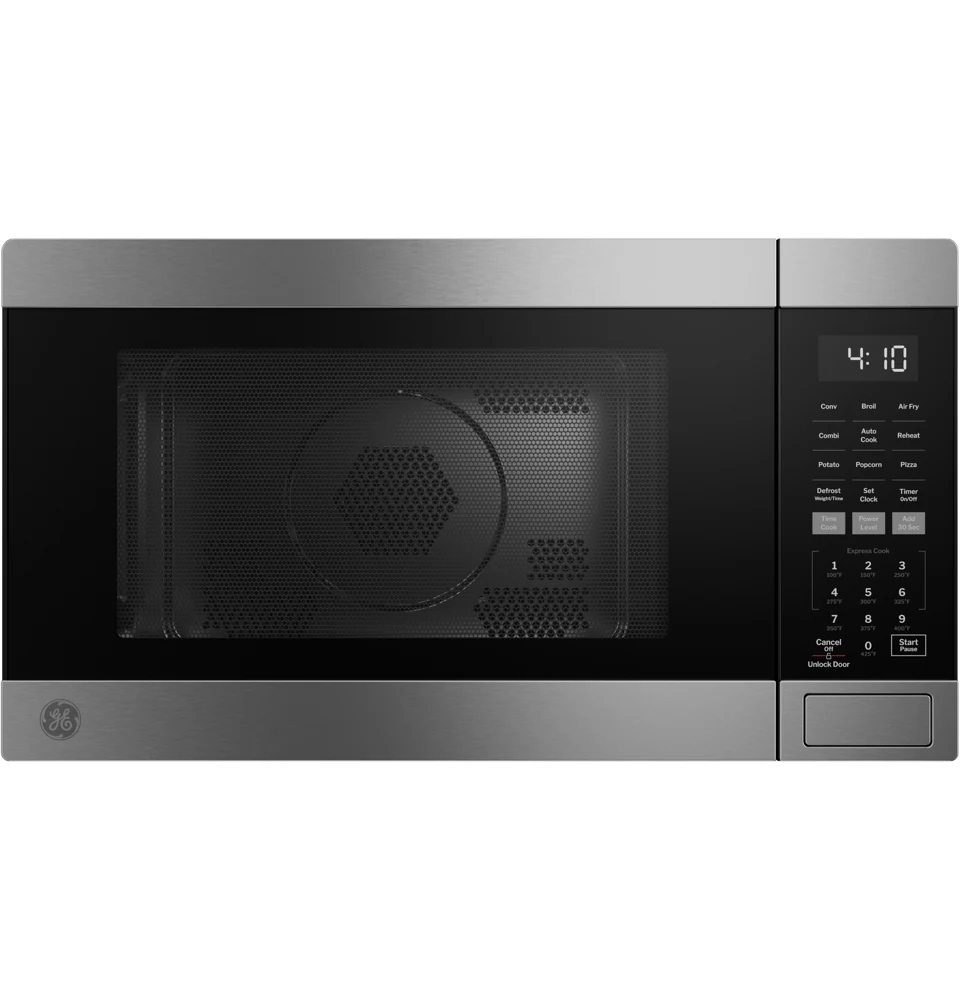
Explore this need in the finder →The GE GCST10A1WSS is a 1.0-cubic-foot convection microwave with air fry and broil modes for someone who wants reheating and small oven tasks in one appliance position. Its advantage is flexibility, not a huge cavity. The useful question is whether your usual crisping or baking portion fits the supplied pan and rack arrangement; a small nominal microwave capacity does not describe how much food you can spread out for air frying.
Start with the second job it will do
A combination appliance is worth considering when it takes over a real routine. If you regularly want a small crisped snack after using the microwave for lunch, one position can serve both jobs. If you already have a convenient air fryer or mostly warm drinks, extra modes may add decisions and accessories without removing much work.
The exact GE owner center identifies GCST10A1WSS as a convection microwave with air fry and links its current manual. Keep that complete code when comparing an offer. The earlier JES1109RRSS is a different identifier, so a similar appearance should not lead you to assume every feature or instruction is interchangeable.
Four methods do not mean one set of cookware
The GCST10A1 manual documents microwave, convection, broil, combination and air-fry controls. It calls for the crispy pan and tall rack in air-fry use and distinguishes that arrangement from microwave cooking. Follow the supplied mode-specific cookware and rack guidance; the convenience of one cavity does not make every container appropriate for every mode.
This is especially important if your current routine is moving a plastic meal box straight from the refrigerator into a basic microwave. A hot oven mode creates a different cookware requirement. Likewise, a pan that is suitable for dry heat is not automatically appropriate for a program using microwave energy. Keeping the accessories accessible and learning the right arrangement are part of the ownership tradeoff.
Air-fry portions depend on usable surface area
A cubic-foot number describes cavity volume, not the area over which you can arrange fries or other pieces. Check the actual supplied pan, the amount of food and the room needed for air movement. If your goal is several servings at once, think through whether repeated batches would offset the benefit of combining appliances.
Our interpretation is that this model is more naturally suited to modest oven tasks than to replacing a large main oven for every meal. Choose it around a repeated small portion and an appropriate dish. A higher-capacity label on a different model is not automatically better either: compare the pan and food arrangement that the cooking mode actually uses.
What the microwave specifications tell you
The exact product record gives a 12.4-inch turntable and a body 20.6 inches wide, 16.6 deep and 11⅞ high. The linked manual identifies 1,050 watts of microwave output. That is the relevant cooking rating to compare with microwave meal directions, rather than an electrical-input or oven-heater figure.
Measure your plate, covered bowl and handled dish separately. A rectangle needs room through a full turn; a tall container needs room below the cavity ceiling and for a safe grip. Rack arrangements further change the usable height in other cooking modes. A dish passing through the door does not establish that every intended cooking setup will be practical.
Sensor and sound requirements need exact evidence
The manual's general cooking-options discussion mentions sensor cooking, but its described Reheat control uses selected serving weight, and the exact evidence reviewed does not establish a humidity-sensor reheat function for the model. Do not choose it specifically to satisfy sensor reheat as an essential feature. Its clearly documented attraction is the additional oven cooking methods.
A switchable mute setting has also not been established. Even where alerts can be disabled on another appliance, that does not silence the cooling system or other mechanical sounds. For a noise-sensitive kitchen, keep verified sound controls separate from the desire for an air-fry mode and check the actual unit's supplied documentation.
Placement and door operation
The manual recommends three inches at each side and above, one inch behind, and no obstruction beneath, with the front-door position set back from the countertop edge. Include door access, the plug and a place to put a hot pan. A convection microwave can leave hot accessories after use, so a workable landing area matters as much as the closed-body footprint.
The current manual also describes child-resistant door operation involving an unlock action before opening. This is distinct from a keypad lock and may differ from the appliance you are replacing. Try the actual sequence while the oven is off if dexterity matters. For any manufacturer-supported setting changes, use the exact instructions supplied with the oven.
How it fits your questionnaire choices
“I want microwaving plus crisping or small oven dishes.” This is the coherent match. Confirm your intended portion, compatible cookware and pan-and-rack setup before assuming it can replace a separate appliance.
“I mainly need a roomy sensor microwave for family leftovers.” A larger microwave with exact sensor documentation is a better starting point. Additional oven modes do not solve a different cavity or automation requirement.
“I want to save one appliance position and accept changing modes.” The combination can be useful, provided the repeated setup and accessory storage are convenient for you.
Our judgment
The owner center records manufacture from July 2024 onward at our check; seller stock and condition still need confirming. Shortlist GCST10A1WSS when one specific small oven task and everyday microwaving fit together comfortably. Choose simpler equipment when the extra modes would rarely be used, or a different size when the food surface area and cookware are the limiting factors.
Key details at a glance
| Nominal cavity | 1.0 cu. ft. |
|---|---|
| Cooking output | 1050 W |
| Turntable diameter | 12.4 in |
| Body W × D × H | 20.6 × 16.6 × 11.875 in; ventilation additional |
Facts apply to the reviewed model and document edition. Read the relevant section for generation differences and installation conditions.
Sources for this assessment
Compare it with your other choices
Use your needs to find alternatives and understand the tradeoffs.