
Your needs, this model
Does it fit your priorities?
Is this a good step up when a small compact will not fit my dinner plate?
Its 12.75-inch tray is worth checking against your actual plate and cover. Measure full rotation and room to lift hot food out; the 1.1-cu.-ft.capacity alone does not settle the fit.
Explore this need in the finder →Does it provide sensor reheat or a verified mute setting?
The exact manual describes portion-entry convenience controls, and a mute setting has not been verified. Do not infer either feature from similar GE models.
Explore this need in the finder →Will its door work like my old one-step microwave?
The manual documents an unlock action before opening the child-resistant door. This is separate from locking the keypad; try the actual operation if dexterity or familiarity matters.
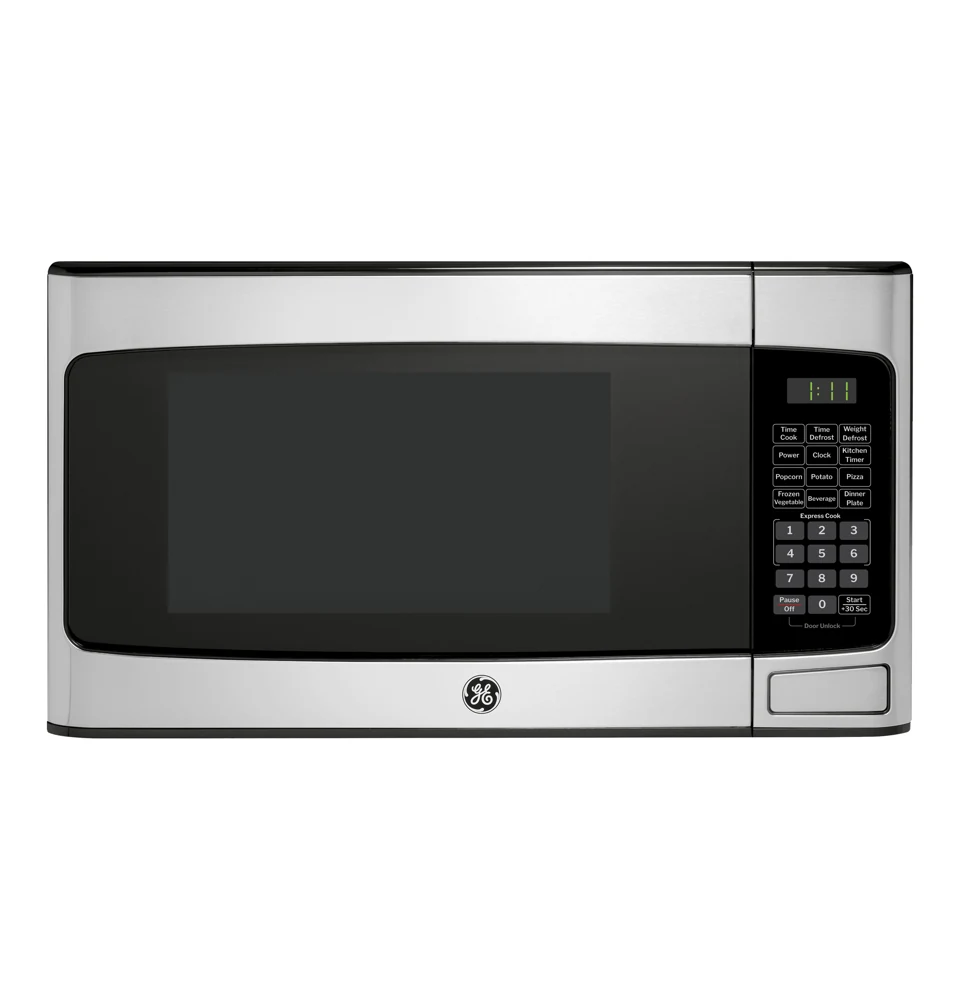
Explore this need in the finder →The GE GCST11N1WSS is a 950-watt microwave for buyers who want a conventional number pad and enough tray space to investigate everyday dinner plates without moving to a large family oven. Its 12.75-inch turntable is the practical reason to compare it with smaller compacts. The limitations are equally clear: sensor reheating and a mute function have not been established, and its newer child-resistant door changes the opening routine.
The step up from a small compact is usable dish space
GE's exact-model specifications describe a 1.1-cubic-foot cavity, 950 watts of microwave output and a 12.75-inch glass turntable. The body is 20 5/16 inches wide, 15⅝ deep and 12 high. The useful comparison is whether that extra tray room saves you transferring food out of the dish you normally use.
For a broad-rimmed plate, measure the full outside edge. For a handled container, include both handles. A rectangular lunch box can pass through a door yet hit a wall as it rotates, so check the full turning path. Think about where a hand or oven mitt will grip the hot item. The nominal capacity can help narrow a list, but it cannot replace those practical checks.
A familiar keypad for repeatable tasks
The GCST11N1 manual documents number-pad time entry, selected express-minute shortcuts and portion-entry food buttons. For someone who wants to warm the same bowl most mornings, a known interval can be more useful than a complex automatic menu. For someone who shares the kitchen, direct time entry also makes it easier to communicate the setting another person should use.
The food buttons do not establish a humidity sensor. In the manual, Dinner Plate uses selected portion amounts; the product specification calls these convenience controls. A person choosing sensor reheating as essential should therefore see another model. An occasional preference for less timing guesswork and a requirement for a real sensor are different answers.
Keep the output rating accurate
The cooking rating is 950 watts. GE separately lists 1,580 watts of electrical input. Those figures serve different purposes: meal directions refer to microwave cooking power, while the appliance's supply requirements matter for electrical planning. A higher input number does not turn this into a 1,500-watt cooking microwave.
For a buyer moving from an older oven, compare the actual output with the instructions used for regular meals. Follow any package guidance for the appropriate wattage. Do not assume that a single percentage adjustment will reproduce every serving, because shape and starting condition affect the result. Our view is that a minimum-output filter is useful when it reflects a real requirement; it should not replace consideration of the controls, dish and available space.
The door lock is separate from locking the keypad
The linked manual describes a child-resistant door operation: an appropriate button action unlocks the door, then the user opens it. It separately describes locking the controls. These are different functions, even though a seller may describe both under a broad child-lock heading.
This matters for accessibility and familiarity. An adult who has used an older one-step microwave for years should not discover a different opening procedure only after the appliance arrives. If hand strength, coordination or reach is important, inspect the actual unit and practice the normal sequence while it is off. The manual explains a supported setting change for households that need it; use that exact supplied guidance rather than applying instructions from another GE model.
Reserve the space needed for use
The manual recommends three inches at the sides and above, one inch at the rear, and at least three inches between the door front and counter edge. These are additional considerations beyond the exterior measurements. The open door, plug, cord route and a place to put a hot bowl also need room.
A 1.1-cubic-foot label can sound modest, but the oven still occupies a useful part of a small kitchen. Mark the proposed footprint before choosing it. If the microwave displaces the only preparation surface and your normal mug fits a smaller oven, the extra tray space may not be worth that tradeoff. If it eliminates a daily dish transfer, the larger body may earn its position.
Which needs point toward it?
“I want straightforward keypad reheating for regular plates.” This is a good reason to compare GCST11N1WSS. Confirm the dish through its full rotation and allow the recommended operating space.
“The oven must provide sensor reheat or switchable mute.” Neither requirement is established by the exact evidence reviewed for this model. The presence of presets and a digital display should not be used to fill those gaps.
“I want microwaving plus browning.” Choose a documented combination model. This oven's rating and capacity do not add a separate dry-heat cooking method.
Our buying judgment
The owner center records manufacture from August 2024 onward at our check, distinguishing it from earlier JES1145 codes with some similar basic specifications. Confirm the complete model on the offer and the accessories supplied. GCST11N1WSS is most convincing when the bigger tray genuinely improves a familiar timed routine; a model with documented sensor or mute features is the better direction when those conveniences drive your choice.
Key details at a glance
| Nominal cavity | 1.1 cu. ft. |
|---|---|
| Cooking output | 950 W |
| Turntable diameter | 12.75 in |
| Sensor reheating | Not supported in reviewed instructions |
| Body W × D × H | 20.3125 × 15.625 × 12 in; ventilation additional |
Facts apply to the reviewed model and document edition. Read the relevant section for generation differences and installation conditions.
Sources for this assessment
Compare it with your other choices
Use your needs to find alternatives and understand the tradeoffs.