
Your needs, this model
Does it fit your priorities?
Would this help with regular plates and changing portions of leftovers?
Its 13⅝-inch tray and documented humidity-sensor controls make that a sensible fit to investigate. Measure the complete dish and room to lift hot food out before deciding.
Explore this need in the finder →Can it be recommended when a mute function is essential?
A switchable mute setting has not been verified for GCST16S1WSS. Choose another exact documented model for that requirement instead of borrowing a Sound feature from another GE version.
Explore this need in the finder →How much space around the body does it need?
The manual recommends 3inches at each side and above, and 1inch behind, plus a front-door setback from the counter edge. Include door movement, electrical access and a landing area for hot food.
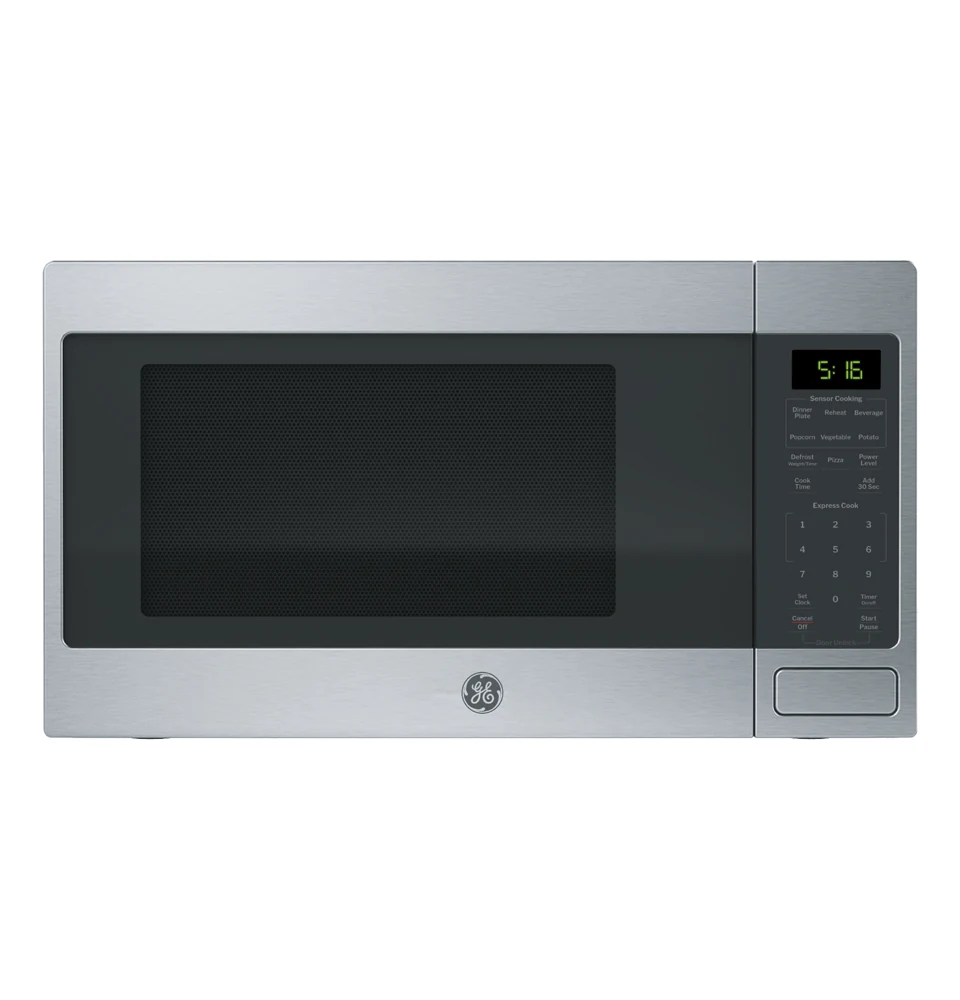
Explore this need in the finder →The GE GCST16S1WSS is a 1.6-cubic-foot sensor microwave for households reheating ordinary dinner plates and changing portions. Its 1,150-watt output and 13⅝-inch glass tray provide useful room without moving to GE's larger 2.0-cubic-foot body. The tradeoff is still substantial operating space, and the newer child-resistant door should be checked for comfortable everyday use.
A useful size only when the plate benefits
GE's exact specifications give a 1.6-cubic-foot cavity, a 13.625-inch turntable and 1,150 watts of microwave output. The body measures 21¾ inches wide, 17¾ deep and 12⅞ high. Those figures make it a relevant comparison when a small compact forces you to transfer dinner onto another plate.
A larger tray does not settle every fit question. Include the outer rim, lid and handles when measuring. A rectangular dish may need more space during rotation than its shorter side suggests, and a tall bowl can limit how you grip it with an oven mitt. The best reason to allocate this much counter space is a repeated meal routine that becomes easier, not the assumption that more volume always improves a microwave.
What the sensor is useful for
The exact product record identifies sensor controls, and the GCST16S1 manual explains humidity-based cooking assistance. That matters when the amount of leftovers varies and you prefer help with the initial timing choice. It distinguishes this model from a smaller oven whose Reheat button simply asks you to select a portion amount.
Think about how you use that assistance. For a familiar small bowl, entering a time you know may be convenient. For a changing plate, an appropriate sensor program can reduce guesswork, followed by checking the result. A dense portion and a delicate ingredient can still respond differently, so the sensor should not be treated as a promise about every part of a mixed meal.
Read the instructions for food, amounts and coverings before making it your default method. If you dislike any adjustment after the first cycle, an automatic label is not a guarantee that the appliance removes that work. The advantage is a documented aid to a decision, not proof of independently measured perfect heating.
Plan for operation around the body
The manual recommends three inches at each side and above, one inch behind, and keeping the front of the door at least three inches back from the countertop edge. That is a larger planning area than the metal case. The open door, plug, cord and a landing area for hot dishes also need consideration.
Use removable tape to sketch the intended position. Check the upper cabinet, nearby wall and the way you approach the controls. If the oven leaves no useful preparation area, compare whether a smaller body can handle the same plate. If a compact makes dinner awkward every evening, the larger footprint can be justified. There is no established exact trim-kit route here, so an enclosed cabinet requires a different, documented installation decision.
The door and keypad locks do different jobs
The linked manual separately describes a control-panel lock and child-resistant door operation. The door unlocks through a button action before opening after a cooking cycle starts. This is not the same as assuming that an ordinary pushbutton behaves exactly like an older microwave.
For someone replacing a familiar appliance, make the opening sequence part of the comparison. Try it while the oven is off if a demonstration unit is available, especially where coordination or hand strength matters. The instructions describe a manufacturer-supported setting change for households that need it. Use the exact supplied manual, because another GE model can use a different mechanism and sequence.
Do you need the higher cooking rating?
The 1,150-watt cooking output is separate from the specified 1,600-watt electrical input at 120 volts. Compare the cooking figure with the power range on meal instructions; use the label and installation guidance for electrical planning. Do not substitute one number for the other.
As a buying judgment, output becomes most useful after size and placement are settled. A higher nominal number does not tell you whether a dish rotates, whether a control suits the user or whether a kitchen remains comfortable to work in. If a minimum output is important for your regular foods, apply it explicitly, then compare the models that meet the rest of the routine.
How the questionnaire should guide you
“I want sensor help for regular plates and changing leftovers.” This is the clearest fit. The tray and sensor controls directly address those needs, provided your actual plate and operating location work.
“I need a verified mute setting.” A mute function has not been established for this exact model. Do not borrow the Sound control from another GCST version. That essential answer should lead toward an exact documented alternative.
“I want crisping or small oven dishes.” Choose an appliance with an appropriate second cooking method. The GCST16S1WSS is a microwave-only choice despite its sensor features and roomy cavity.
Our conclusion
The GE owner center records this as a September 2024 generation with ongoing manufacture at our check. A seller's stock and condition still need confirming. Shortlist it when the extra dish room and sensor assistance make everyday dinner easier; choose a smaller oven if they add little to your own tasks, or a documented mute model if sound control is a deciding requirement.
Key details at a glance
| Nominal cavity | 1.6 cu. ft. |
|---|---|
| Cooking output | 1150 W |
| Turntable diameter | 13.625 in |
| Sensor reheating | Documented |
| Body W × D × H | 21.75 × 17.75 × 12.875 in; ventilation additional |
Facts apply to the reviewed model and document edition. Read the relevant section for generation differences and installation conditions.
Sources for this assessment
Compare it with your other choices
Use your needs to find alternatives and understand the tradeoffs.