
Your needs, this model
Does it fit your priorities?
Does it suit broad dishes plus sensor help and muted beeps?
That is its strongest combination: the 16-inch tray, sensor controls and Beeper On/Off are documented. Confirm full dish rotation and the substantial operating area before buying.
Explore this need in the finder →Will I need space to reach a side control when opening the door?
Yes. The manual describes holding a side lock button while pressing the front door release. Check comfortable access where the oven will sit, especially beside another appliance or wall.
Explore this need in the finder →Is it a natural choice if compact size matters most?
Start smaller unless a real piece of cookware needs this tray and cavity. Unused volume does not compensate for losing preparation space or an awkward door arrangement.
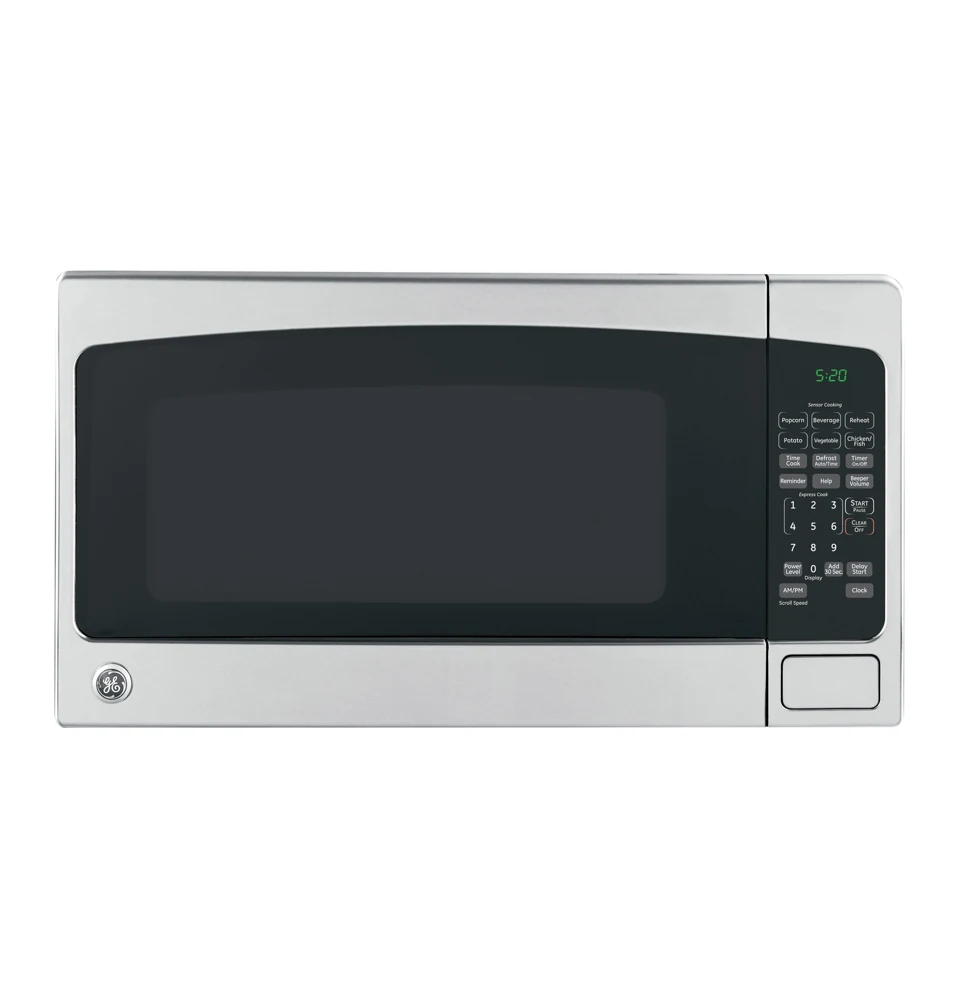
Explore this need in the finder →The GE GCST20S1WSS is a large 1,200-watt sensor microwave for buyers whose broad dishes need a 16-inch tray. It also documents switchable beeps, making it relevant when you want both large-dish space and control of alert sounds. The main compromise is the operating area and door arrangement: this is a substantial countertop appliance, with a side-button child-resistant release that deserves a physical access check.
Choose the large body around a real piece of cookware
The exact GE specification identifies a 2.0-cubic-foot cavity, 1,200-watt output and a 16-inch rotating glass tray. Its body is approximately 24.09 inches wide, 19.4 deep and 13.75 high. Do not assume it shares every exterior measurement with the earlier JES2051 model merely because both have a large tray.
Check the dish that makes you want this size. A wide dinner plate is different from a casserole with projecting handles; a tall covered bowl adds another constraint. Include full rotation, clearance through the doorway and room for an oven mitt. A big nominal cavity can still be an awkward shape for a particular container. Its value comes from solving that actual fit problem.
Sensor reheating is relevant to changing meals
The GCST20S1 manual documents sensor and manual cooking controls. Sensor assistance is useful when your portion varies and you want help choosing an initial cycle. A direct timed setting remains useful for a small task you already know. Neither approach needs to be used for everything.
Do not combine two separate buying assumptions: a broad tray does not mean every large amount should use the sensor, and a sensor does not prove that every ingredient on a mixed plate heats alike. Follow the exact instructions for the food and amount. For a substantial serving, you may prefer a manual approach that lets you manage stirring and check a dense center without relying on a category label.
Our judgment is that the sensor and large dish space work best as complementary conveniences. They make the model worth comparing for a leftover-heavy household. They are not an independent cooking test, and a person heating only a mug may gain little from either.
Switchable beeps are a distinct benefit
The manual includes Beeper On/Off, which turns signal sounds off and on. That is direct support for a questionnaire answer requiring mute, rather than an assumption made from another GE model. A household preparing food early or late can make use of that control.
The word mute still needs a boundary. Fan noise, opening the door, tray movement and cookware are separate sound sources. A beep setting is not evidence that the appliance runs quietly enough for every nearby sleeping space. If low running noise is the main issue, inspect the actual model and compare measured information when available rather than relying on the alert control alone.
The side-button door needs access
The linked manual describes a physical child-resistant release: a side lock button is held while the front door-latch release is pressed. This differs from the control-panel lock and from smaller GE models that unlock through a keypad action. It should be part of your location and accessibility check.
Make sure you can comfortably reach the actual mechanism where the oven will sit. A narrow gap beside a wall or another appliance can turn a normal daily action into an inconvenience. Someone with restricted dexterity should try the opening arrangement while the oven is off if possible. Refer to the supplied instructions for the manufacturer's supported setting options rather than copying a procedure from a different GCST model.
The countertop must remain usable
The manual recommends three inches at each side and above, one inch behind, and a front-door setback from the counter edge. Include those conditions, door movement, electrical access and a place to set down hot food. The approximate body measurements alone are not the complete space requirement.
If the appliance fills the only preparation surface, decide whether the widest dish genuinely requires this oven. A smaller microwave that fits your everyday plate can be easier to live with. On the other hand, if every dinner currently needs transferring to smaller dishes, the larger space may solve a repeated irritation. No exact trim-kit route has been established here, so a cabinet opening should not be treated as an approved alternative to the open counter.
How your choices change the recommendation
“I use broad dishes, want sensor help and need beeps off.” This is the model's strongest combination. Confirm the cookware and actual installation first, then the documented sensor and sound functions make useful differentiators.
“Compact size is my priority.” Start with a smaller body unless a measured dish requirement rules it out. Unused capacity does not compensate for a cramped worktop.
“I need browning or air frying.” Choose a documented combination appliance. The high microwave rating does not create an additional dry-heat cooking system.
Our assessment
The owner center records a July 2024 generation with ongoing manufacture at our check. Verify the exact offer and supplied accessories separately. GCST20S1WSS is a strong candidate for a specific large-dish routine with muted alerts; its substantial operating footprint and side-release access are the reasons to measure carefully before choosing it.
Key details at a glance
| Nominal cavity | 2.0 cu. ft. |
|---|---|
| Cooking output | 1200 W |
| Turntable diameter | 16 in |
| Sensor reheating | Documented |
| Alert mute setting | Documented |
| Body W × D × H | 24.0938 × 19.4 × 13.75 in; ventilation additional |
Facts apply to the reviewed model and document edition. Read the relevant section for generation differences and installation conditions.
Sources for this assessment
Compare it with your other choices
Use your needs to find alternatives and understand the tradeoffs.