
Your needs, this model
Does it fit your priorities?
Is it a good fit for everyday dinner plates and changing leftovers?
Its documented 13⅝-inch tray and sensor controls make it worth comparing. Check the complete plate or container through a full rotation, and include the space needed to lift it out safely.
Explore this need in the finder →Will it fit if I only have room for the metal body?
No. The linked manual recommends 3 inches at each side and above, and 1inch behind, plus front-edge placement and door access. Body dimensions alone do not establish a usable installation.
Explore this need in the finder →Can I choose it when muting beeps is essential?
A mute setting has not been verified for this exact model. Do not borrow the Sound control from another GE generation; choose a documented mute model when that feature is essential.
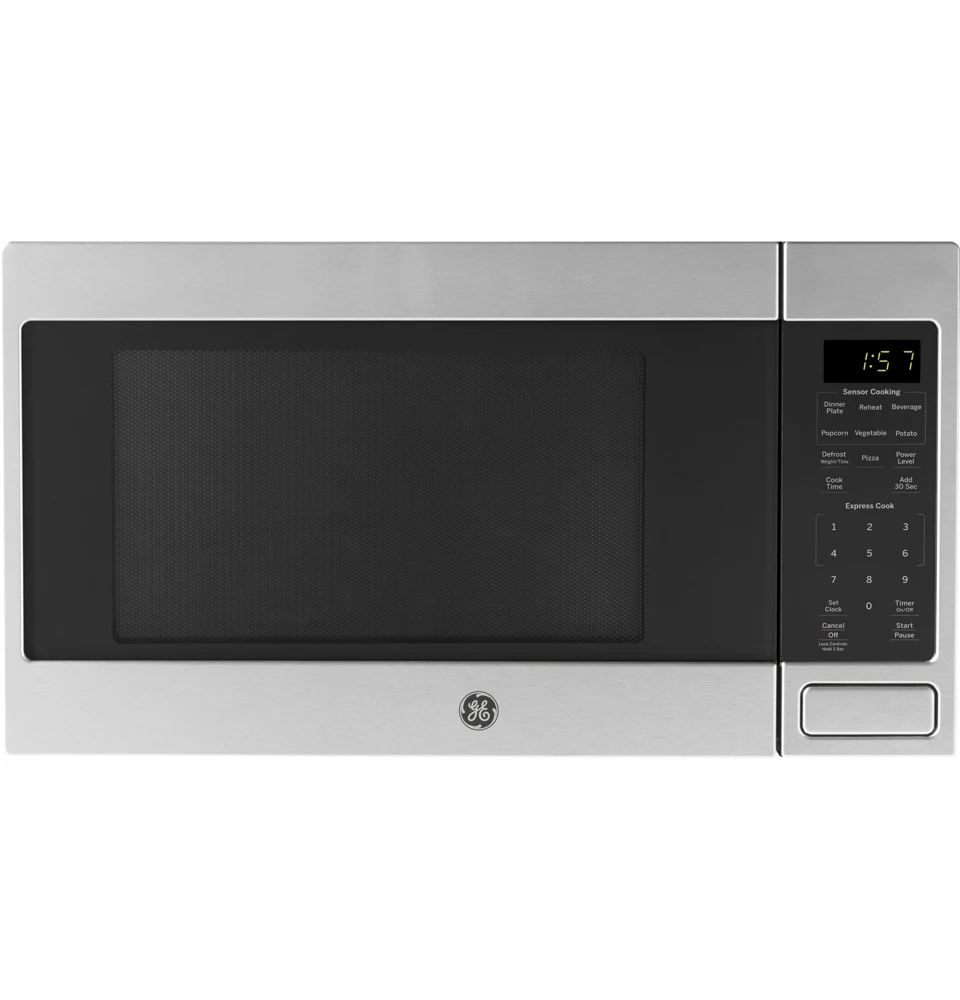
Explore this need in the finder →The GE JES1657SMSS is an earlier 1.6-cubic-foot sensor microwave that suits ordinary plated leftovers when you have room for a medium-to-large countertop body. Its 1,150-watt output and 13⅝-inch tray are the useful comparison points. GE now says it is no longer manufactured, so judge any purchase as a specific seller's offer and condition rather than assuming it is a current new-production model.
A middle-size choice for dinner rather than just a mug
A microwave earns its space when the food you regularly reheat fits comfortably. GE's exact JES1657SMSS product specifications list a 1.6-cubic-foot cavity, a 13.625-inch glass turntable and 1,150 watts of cooking output. The body is 21¾ inches wide, 17¾ deep and 12⅞ high. Those figures place it beyond a small drinks-and-snacks appliance without making every large serving dish an automatic fit.
For a household that reheats on ordinary dinner plates, this is a reasonable size to investigate. Check the plate rim and any cover, then think about a hand or oven mitt lifting it back out. For a rectangular container, check its full rotating path. A dish that slides into the opening can still hit a wall at another angle, and nominal capacity cannot answer that question.
What sensor controls contribute
The GE-linked JES1657 manual explains humidity-based assistance and the need to follow the food and covering instructions. In everyday terms, that helps with the initial timing decision when yesterday's portion is not always the same size. It is a different benefit from simply having a Dinner Plate label on a keypad.
Do not treat the sensor as a promise that every combination on a plate finishes equally. A dense center, an exposed edge and a small delicate ingredient can need different handling. The useful routine is to choose a suitable program, follow the supplied preparation guidance and assess the result. Our recommendation credits the documented assistance without inventing a measured heating advantage over another model.
If your microwave use is mostly a familiar mug or small bowl, sensor assistance may be less important than a compact operating footprint. If you regularly reheat changing dinner portions, it may be worth allocating the extra space. That distinction is more helpful than assuming larger households always need larger ovens.
Power settings and electrical requirements are not the same thing
The 1,150-watt figure describes microwave output. GE separately lists 1,600 watts of electrical input at 120 volts. Package cooking directions and electrical planning use different information, so do not swap those numbers when comparing ovens or power sources.
For the buyer, a minimum output requirement is a useful way to narrow a list only when there is a real reason behind it. It does not measure how every food will turn out. A microwave with a slightly higher nominal rating is not automatically a better fit than one whose tray, controls and placement suit the routine. Start with the meal and installation requirements, then compare the remaining output differences.
Leave room around the case
The exact-family manual recommends three inches of clearance at each side and above, plus one inch behind. It calls for the door's front surface to sit at least three inches back from the countertop edge. These are additional placement considerations beyond the metal body's width, depth and height.
Sketch that arrangement on the counter before ordering. A nearby refrigerator wall can obstruct the door even if the body fits. A low upper cabinet can remove the top clearance, and a crowded socket area can complicate the back of the appliance. Keep enough landing space for a hot bowl so the microwave does not make the food-preparation area harder to use.
No approved trim-kit route has been established for this exact model in this review. Do not approve an enclosed installation because the case happens to fit a cabinet cutout. A countertop model and a documented built-in system are different installation choices.
Where the questionnaire should put it
“I reheat regular dinner portions and prefer sensor help.” That is the clearest match, after checking cookware and operating space. The sensor and tray directly address the routine rather than adding an unrelated feature.
“I need to turn all the beeps off.” A mute setting has not been verified for this exact model. Do not borrow the Sound control from another GE generation. A sound requirement should remain unmet until the actual model and supplied instructions confirm it.
“I want baking, browning or air frying.” The documented cooking technology is microwave cooking. A large cavity or high output does not supply a separate oven mode, so compare a suitable combination appliance instead.
“I want to include earlier models for a particular offer.” This is where JES1657SMSS belongs. GE's owner center records manufacture from June 2018 through September 2024. The date range explains its earlier-model status but does not determine the condition of a unit advertised today.
Our buying judgment
Shortlist a specific JES1657SMSS offer when its sensor controls, plate space and familiar keypad fit your needs. Check the complete model code, supplied tray and support, seller return terms and actual condition. Pay particular attention to the door and seal surfaces on a used unit, and use qualified service rather than attempting internal repairs. For a buyer without a specific earlier offer to evaluate, a documented current alternative can be simpler to source and compare.
Key details at a glance
| Nominal cavity | 1.6 cu. ft. |
|---|---|
| Cooking output | 1150 W |
| Turntable diameter | 13.625 in |
| Sensor reheating | Documented |
| Body W × D × H | 21.75 × 17.75 × 12.875 in; ventilation additional |
Facts apply to the reviewed model and document edition. Read the relevant section for generation differences and installation conditions.
Sources for this assessment
- https://www.geappliances.com/appliance/GE-1-6-Cu-Ft-Countertop-Microwave-Oven-JES1657SMSS
- https://images.salsify.com/image/upload/s--1cCUZ9NG--/u1qbfistkxgxuikxhalm.pdf
- https://products.geappliances.com/appliance/gea-specs/JES1657SMSS/parts
- https://www.geappliances.com/content/pro/downloads/1-G0300.pdf
Compare it with your other choices
Use your needs to find alternatives and understand the tradeoffs.