
Your needs, this model
Does it fit your priorities?
Does it suit broad dishes and larger plated meals?
Its 16-inch tray makes it a relevant large-dish candidate, but check your dish’s handles, doorway clearance and full rotation. The 2.0-cu.-ft. volume does not guarantee every casserole fits.
Explore this need in the finder →Can I switch the beeps off?
Yes. The linked manual’s Beeper Volume control offers 0–3, with 0 identified as mute. It does not silence the fan, door or other mechanical sounds.
Explore this need in the finder →Is it a good choice when saving counter space matters most?
Usually start smaller unless a dish you regularly use needs this tray and cavity. Mark out the large body and required operating space, including door access and a place for hot food.
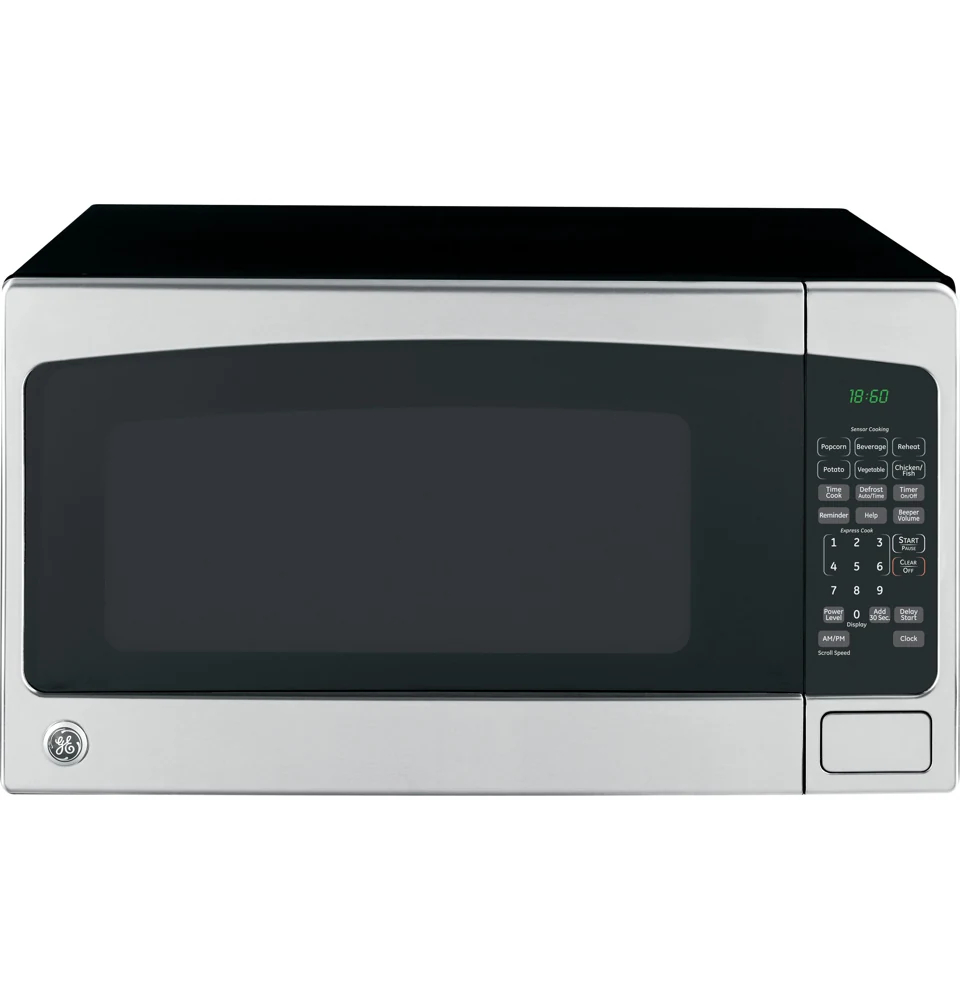
Explore this need in the finder →The GE JES2051SNSS is an earlier large countertop microwave for buyers whose actual cookware benefits from a broad 16-inch rotating tray. It combines sensor controls with 1,200-watt output and adjustable alert volume. The tradeoff is the space occupied by a nearly 24-inch-wide body, plus ventilation and door access. Choose it around a real dish or meal routine rather than the 2.0-cubic-foot number alone.
Big-dish space is the reason to compare it
GE's exact product record specifies a 2.0-cubic-foot cavity, 1,200 watts of microwave output and a 16-inch glass turntable. The body is 23⅞ inches wide, 19¼ deep and 13⅝ high. It is a sensible candidate when smaller ovens make you transfer a meal or abandon a favorite dish; it is unnecessary extra bulk when your usual task is a small mug.
Even at this size, tray diameter is not a guaranteed dish limit. Handles and square corners may collide during rotation. A large dish can also leave too little room for oven mitts, or fit the interior but not pass conveniently through the door. Bring the measurements of your widest actual cookware into the decision. “Family-size” is a broad description; your own casserole has exact dimensions.
Sensor assistance for changing portions
The documented sensor controls make this model relevant to a household reheating leftovers that vary from meal to meal. They can reduce the initial timing choice, while manual time and power settings remain useful for familiar tasks. A sensor setting should be selected because its food category and instructions suit the serving, not because automatic operation is always better.
Consider a plate containing rice, a dense piece of protein and a small amount of vegetables. Each part behaves differently. The presence of a sensor does not establish that all three finish at the same time, and it is not a food-safety test. Our interpretation is that the convenience supports a shortlist requirement, while stirring, checking and choosing appropriate intervals remain part of the routine.
The sound setting is a documented advantage
The GE-linked manual includes beeper volume settings from zero through three, with zero identified as mute. That provides concrete support for a shopper who wants to turn off alert tones. It is better evidence than assuming any large GE microwave has the same control as a newer or neighboring model.
Muted tones do not mean silent operation. The door, cooling system, turntable and cookware can still make sound. If the microwave will sit near someone sleeping, separate the preference for no beeps from the demand for very low running noise. This review does not have a measured sound level or a comparative noise test, so it does not turn the volume control into a quietest-model claim.
Check the counter as carefully as the cavity
A large interior can solve a cookware problem while creating a workspace problem. Mark the body on the counter and reserve the ventilation and front-edge placement required by the actual instructions. Check where the door opens and where you will set down the hot container. If it covers the only usable food-preparation area, compare whether a smaller dish or a different appliance location would be more practical.
The documented installation type is countertop. No exact approved trim-kit route has been established for JES2051SNSS here. The fact that another GE microwave can be built in does not make an enclosure suitable for this one. If you are replacing a cabinet installation, begin with a model-and-kit compatibility check rather than the nominal oven capacity.
Electrical draw and cooking output
GE lists 1,650 watts of electrical input separately from the 1,200-watt cooking rating. Use the appliance's actual supply and circuit instructions when planning installation; the lower output number is not a power-source sizing figure. For a food package, compare the cooking rating with the wattage guidance printed on that package instead.
Our view is that output should be treated as one compatibility factor, not a universal performance score. A buyer who already has a suitable large dish and needs a particular cooking range can use it to narrow the shortlist. A buyer reheating small delicate portions may care more about controls and the ability to manage a short interval than about the highest number.
How it fits your answers
“I want room for broad dishes, sensor help and muted beeps.” The documented tray, sensor controls and zero-volume setting make this a coherent match. Physical dish and operating-space checks still come first.
“My main goal is to keep the counter open.” This large body is unlikely to be the natural starting point. Compare the smallest oven that can actually handle your dishes instead of maximizing unused cavity volume.
“I want to brown or bake as well as microwave.” This is a microwave-only cooking choice. High output and a roomy cavity do not supply convection or another dry-heat system.
“I am evaluating an earlier unit.” GE now says this model is no longer manufactured, and its owner center lists a July 2008–December 2024 manufacture period. Check the actual offer, accessories, condition and return arrangements. Do not assume an old identifier or an attractive product image proves the seller's item is the exact stainless model.
Our conclusion
The JES2051SNSS earns consideration when broad cookware, documented sensor assistance and switchable tones solve real everyday needs. Its weakness is the substantial installation area and the extra checking involved in buying an earlier model. The right reason to choose it is that smaller alternatives fail a measured requirement, not that a larger cubic-foot figure automatically promises a better microwave.
Key details at a glance
| Nominal cavity | 2.0 cu. ft. |
|---|---|
| Cooking output | 1200 W |
| Turntable diameter | 16 in |
| Sensor reheating | Documented |
| Alert mute setting | Documented |
| Body W × D × H | 23.875 × 19.25 × 13.625 in; ventilation additional |
Facts apply to the reviewed model and document edition. Read the relevant section for generation differences and installation conditions.
Sources for this assessment
- https://www.geappliances.com/appliance/GE-2-0-Cu-Ft-Capacity-Countertop-Microwave-Oven-JES2051SNSS
- https://images.salsify.com/image/upload/s--NMz47zu2--/c1d13b3576c725b58b316097e5c9d2a0564550d2.pdf
- https://products.geappliances.com/appliance/gea-specs/JES2051SNSS/support
- https://www.geappliances.com/content/pro/downloads/1-G0300.pdf
Compare it with your other choices
Use your needs to find alternatives and understand the tradeoffs.