
Your needs, this model
Does it fit your priorities?
Is it a middle ground for everyday dinner plates?
Its 1.5-cu.-ft. cavity and 14.2-inch tray make that a useful starting point. Check your actual dish with lid and handles; nominal volume does not guarantee door clearance or free rotation.
Explore this need in the finder →Are both sensor and inverter documented?
Yes. The model page and family specification explicitly identify Smart Inverter, Sensor Cook and Sensor Reheat. Food category, cover and standing instructions still matter.
Explore this need in the finder →Can I choose it for essential mute or a cabinet kit?
Neither is confirmed by the reviewed exact-model record. A completion beeper and control child lock are documented, but those do not establish a sound-off setting or trim-kit installation.
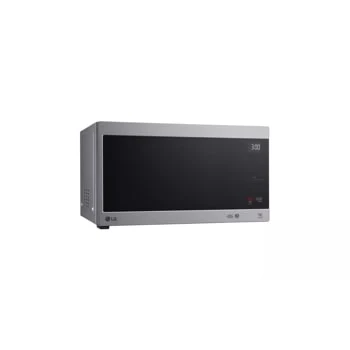
Explore this need in the finder →The LG LMC1575ST is an earlier mid-size microwave for everyday dinner plates, documented sensor reheating and inverter power delivery. It offers a useful middle ground between a compact personal oven and a very large family model. Its main limitations are the need to check the actual control arrangement and the absence of a confirmed mute or exact trim-kit route in the reviewed record.
Choose the middle size for a reason
A 1.5-cu.-ft. cavity is relevant when your usual plate or bowl feels cramped in a smaller microwave but you do not want the largest body on the counter. LG's specification sheet gives a 14.2-inch tray and a cavity approximately 15.43 inches wide, 10.31 high and 15.98 deep. A handle or lid can still be the part that decides whether your dish fits. LG LMC1575 family specifications.
Do not use nominal volume as a substitute for checking your cookware. A shallow round plate and a tall rectangular container can have the same serving size yet behave differently at the door and while rotating. If the dish that bothers you is the reason for upgrading, measure that dish first and keep those measurements visible while comparing models.
Sensor and inverter are both explicit here
LG documents Smart Inverter, Sensor Cook and Sensor Reheat for the LMC1575 family, and the exact ST page identifies the stainless model. Those are separate, useful features: sensing helps estimate an appropriate program, while inverter power control concerns how microwave energy is delivered. Neither guarantees that every meal heats evenly without attention. LG's exact ST model page.
This pairing makes sense when your routine varies. A lunch bowl one day and a dinner plate the next can benefit from automatic assistance, while lower-power manual cooking remains available for more deliberate tasks. Someone who always uses a known full-power interval may care more about an obvious start button than the extra technology.
Programs are organized around food, not every possible meal
The specification sheet lists seven sensor-cook choices, five sensor-reheat choices and four defrost categories. That gives you a useful range of starting methods, but it does not mean every item in a mixed container should be treated as the same category. Read the supplied instructions for portions, covers and standing time before relying on a shortcut.
For a dense serving, distribute food as sensibly as the dish allows and check the center after the instructed program. If the meal is only partly ready, use appropriate additional manual heating rather than assuming the same automatic selection should simply be repeated. A microwave that helps estimate time still leaves you responsible for deciding whether the food is ready to eat.
Inspect both parts of the control layout
LG describes SmoothTouch glass and panel-touch controls. A photograph of the closed front may not show every cooking control you will use. Check the actual arrangement for selecting power, entering a time, adding a short interval and cancelling. Someone with a strong preference for conventional number keys should verify those keys on the offered unit rather than interpreting the word touch as a complete description.
The model also has a control child lock. That prevents unintended operation when set; it does not establish an accessible door-release mechanism or the presence of a separate physical latch. If a household member needs easy grip or a particular opening sequence, those requirements deserve a direct check of the exact revision.
Measure the counter after adding ventilation
LG's exterior specification is approximately 21.41 inches wide, 17 deep and 12.13 high. Those are appliance dimensions. The final position needs the clearances in the actual owner's manual, room for the plug and sufficient space to open the door and remove a hot dish. This review does not turn a body-size match into approval for an enclosed shelf.
It is worth checking the kitchen at its busiest. Can another person use the neighboring worktop while you load a plate? Is there a place to put it down? A slightly smaller microwave that leaves that space free may be more useful than an attractive larger model that interrupts the whole preparation area.
Output, input and sound should stay separate
The sheet clearly identifies 1,200-watt cooking output and a separate 1,600-watt, 14-amp input line. Another nearby “1,250 Microwave” phrase is not explained, so it is not used here as a competing electrical specification. Follow the actual label for electrical installation and use the output rating when interpreting food directions.
LG lists a completion beeper, but the reviewed record does not establish an exact-model mute setting. Inverter marketing also does not supply a whole-appliance noise measurement. If quiet alerts are essential, keep this uncertainty visible rather than assuming that smooth power delivery means silent operation.
When this older model is worth comparing
The ST is stainless steel, distinct from the black-stainless BD version. Use the complete model code when checking an offer, and verify condition, included tray, returns and the supplied manual. The earlier-model designation in our finder concerns the documented model generation; it does not make a claim about today's stock at any particular store.
It should come forward for regular plates, verified sensor and inverter preferences, flexible controls and adequate open-counter space. It should move back for essential mute, confirmed built-in compatibility or the smallest possible body. That makes it a specific answer to a set of kitchen needs, rather than a universal best microwave.
Key details at a glance
| Nominal cavity | 1.5 cu. ft. |
|---|---|
| Cooking output | 1200 W |
| Turntable diameter | 14.2 in |
| Sensor reheating | Documented |
| Inverter power control | Documented |
| Body W × D × H | 21.41 × 17 × 12.13 in; ventilation additional |
Facts apply to the reviewed model and document edition. Read the relevant section for generation differences and installation conditions.
Sources for this assessment
Compare it with your other choices
Use your needs to find alternatives and understand the tradeoffs.