
Your needs, this model
Does it fit your priorities?
Does1.6cuft always mean the same countertop depth?
No. The SC73LS body is 17 3/4 inches deep, while SN76LS is 19 7/16 inches. Compare the full clearance instructions as well.
Explore this need in the finder →Is it a good choice for leftovers with number-pad timing?
Its documented Sensor Reheat and numeric controls fit that routine. Check your dish and actual edition.
Explore this need in the finder →Can I assume this is a current-generation purchase?
Panasonic support identifies the SC73LS as discontinued. Include it only if an earlier model and verified seller condition are acceptable.
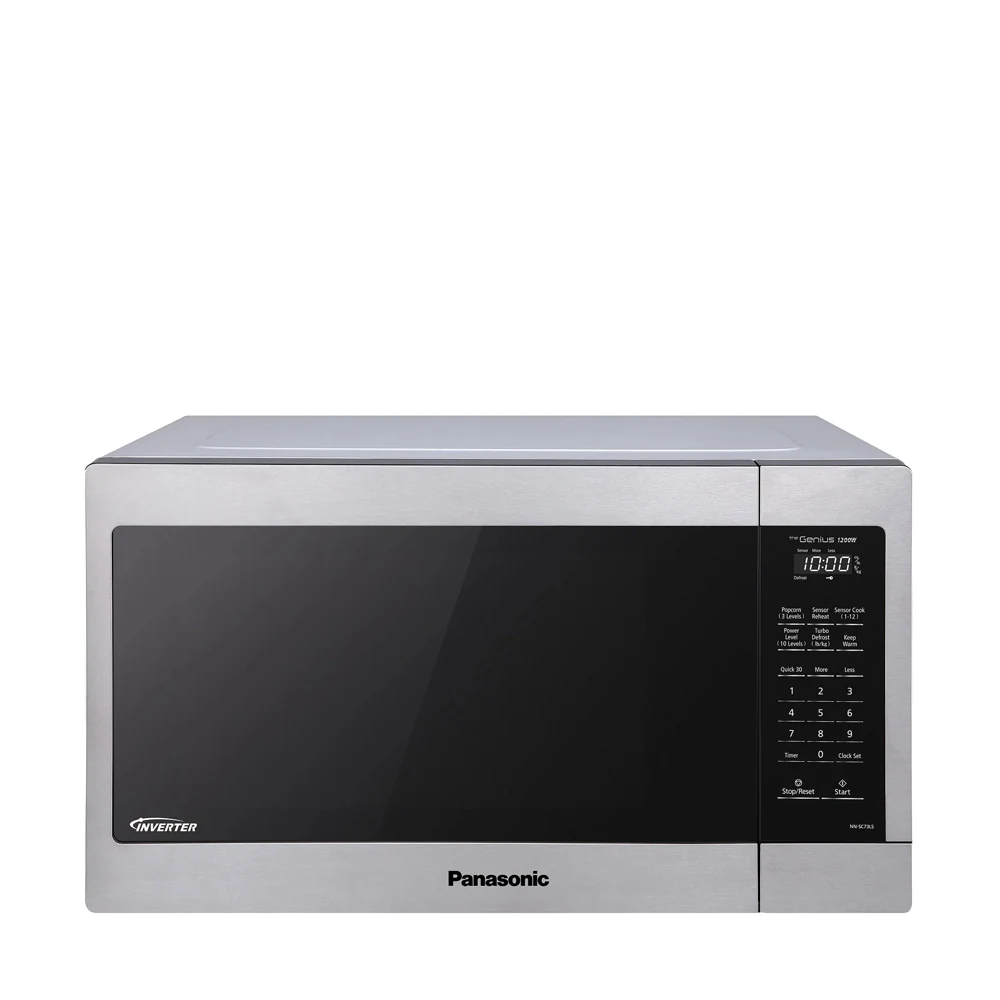
Explore this need in the finder →The Panasonic NN-SC73LS is a documented earlier 1.6-cu.-ft. inverter microwave for buyers who want room for everyday meals without moving to a nearly 24-inch-wide family model. It offers 1,200-W cooking output and Sensor Reheat with numeric controls. Its appeal is the middle-size format; buyers should check the actual edition and seller condition because Panasonic's support guide identifies it as discontinued.
Start with the counter depth you can spare
A medium-capacity microwave can be a better choice than either a cramped compact model or the largest available oven. The SC73LS is especially relevant when you want a wider cavity for meals but do not want the front-to-back body depth of Panasonic's SN76LS. The two are both described as 1.6-cu.-ft. models, yet their outside shapes are different.
The SC73LS product page gives a body21 3/4 inches wide,12 13/16 inches high and 17 3/4 inches deep. The SN76LS is 19 7/16 inches deep. That difference can matter on a counter where a deep oven would push the door and a hot plate toward the edge. Compare the complete installation instructions, however, rather than assuming a smaller body always needs less operating space.
The linked original manual calls for 12 inches above and an open right side, alongside its adjacent-wall gap; confirm the instructions for the actual US edition. Use tape to mark the planned footprint and required clearance. Then walk through loading a plate and setting it down afterward. A microwave can physically sit on a worktop while leaving the kitchen awkward to use. Also check the outlet position and door swing rather than planning only a closed-door rectangle.
How much does the larger cavity really help?
The manufacturer's nominal12.4-inch turntable is a useful starting point for an ordinary circular plate. It is not a guarantee that every 12.4-inch dish fits the opening or turns without touching a wall. A handled bowl or square container can need more space than its nominal serving size suggests.
Compare your usual dinner plate, your tallest covered bowl and any awkward casserole. If all three already fit comfortably in a smaller model, the added cavity may not be worth the counter allocation. If your present plate crowds the walls, the medium format is worth examining. The relevant benefit is easier loading of your real food, not capacity as an abstract number.
This remains a single-level microwave cooking space. It should not be chosen on an assumption that it can heat a collection of separate dishes as a conventional oven would. For a family serving food in succession, a repeatable reheating routine may matter more than the last fraction of nominal volume.
Sensor Reheat is useful for cooked meals
The exact model's official page documents Sensor Reheat, and the linked original manual explains sensor-based cooking rather than a simple serving-count reheat timer. That suits someone reheating cooked refrigerated meals who would rather avoid estimating the first time setting. It is less decisive for a user whose main routine is a short drink or one small snack.
Choose the automatic function for the food it describes. Portions, covering and moisture are part of that method. A sensor cannot make pastry, a mug and a dense chilled plate behave as one category. Follow the applicable instructions and do not interrupt the sensing stage just because the remaining time has not appeared yet.
Once the process allows it, stirring or rearranging can help with a mixed plate. Allow the specified standing time and check the food before serving. Inverter and sensor labels document capabilities, not a measured promise that the center of every meal will match the temperature at the edge.
Power and number-pad operation
The output rating is 1,200 W. When moving from a lower-output oven, a familiar full-power time can be too long. Use the appropriate guidance on the package and learn a setting for your normal portion. Controlled reheating is often about choosing a suitable power level rather than applying the highest setting to every food.
The documented control panel has number pads, separate Sensor Reheat and Sensor Cook buttons, Quick30 and dedicated power selection. That is a useful arrangement for someone who likes entering a known time directly. It is not a dial model, and the touch surface should be judged for readability and comfort by the person who will use it most.
Do not choose between two microwaves by the largest automatic-menu total alone. The SC73LS manufacturer page contains different menu counts in different sections. What matters to daily use is whether the actual panel and matching manual provide the routines you want. The exact appliance is a better guide than an abbreviated listing headline.
Sound, installation and edition checks
A mute procedure has not been established for this exact reviewed edition. If beep-free alerts are essential, select a model with explicit documented support rather than borrowing instructions from another SC-series Panasonic. Even a verified mute function on an alternative will not silence its fan or door.
The linked original SC73 manual is Canada-oriented, while the US shop separately confirms the exact model and body specification. Do not assume that its Canadian warranty terms describe a US seller's unit. Use the supplied US documentation to settle ventilation, circuit instructions and the actual door-lock procedure before installation.
Likewise, no exact approved trim-kit path is established in this review. Treat the SC73LS as an open-counter candidate. Its appearance and nominal capacity do not approve a frame intended for a different Panasonic. A close-fitting shelf or cabinet needs more than a body-size comparison.
Our recommendation
Consider the SC73LS when medium-size meals, numeric timing and less body depth than the SN76LS are useful, and an earlier model is acceptable. Compare a current documented alternative if seller condition, edition or installation information cannot be resolved. Choose a smaller unit if your routine is genuinely small; choose a combination oven if browning is part of the requirement. The SC73LS earns its place through its shape and reheating functions, not a claim that every older offer is the same.
Sources
- Panasonic US SC73LS product page
- Exact-model support status
- Original linked operating manual
- Panasonic exact-model specifications
Key details at a glance
| Nominal cavity | 1.6 cu. ft. |
|---|---|
| Cooking output | 1200 W |
| Turntable diameter | 12.4 in |
| Sensor reheating | Documented |
| Inverter power control | Documented |
| Body W × D × H | 21.75 × 17.75 × 12.8125 in; ventilation additional |
Facts apply to the reviewed model and document edition. Read the relevant section for generation differences and installation conditions.
Sources for this assessment
Compare it with your other choices
Use your needs to find alternatives and understand the tradeoffs.