
Your needs, this model
Does it fit your priorities?
Does Auto Reheat mean it has a humidity sensor?
The reviewed original manual describes pre-timed serving choices rather than steam sensing. It does not satisfy a required sensor filter.
Explore this need in the finder →Is it worth comparing for a small kitchen and modest meals?
The 0.8-cu.-ft. format suits a modest-portion routine. Check your largest normal dish and the ventilation gaps.
Explore this need in the finder →Does it use a number pad?
It sets time and weight with a dial plus function buttons. Compare it if you prefer that interaction.
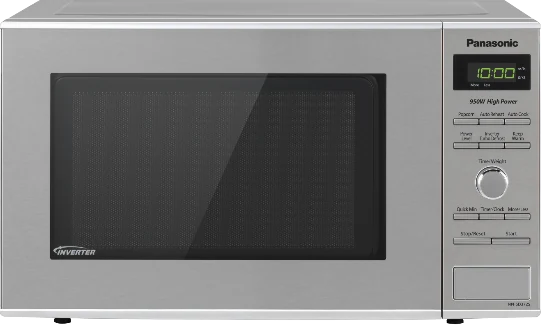
Explore this need in the finder →The Panasonic NN-SD372S is a compact earlier inverter microwave for a small countertop and a user who prefers a time/weight dial. Its950-W cooking output and0.8-cu.-ft. format suit modest portions. An important distinction is that the reviewed original manual uses pre-timed Auto Reheat, not verified humidity-sensor reheating, so it should not satisfy a requirement for a steam sensor.
A smaller body for a simpler meal routine
If your typical use is a small bowl, snack or individual portion, a large microwave may occupy space you would rather use for preparation. The NN-SD372S is relevant to that situation. The useful starting question is which container has to fit every day, not whether a larger capacity sounds more capable.
The original specification page labels its dimensions in W×D×H order:19 3/16 inches wide,14 13/16 inches deep and11 inches high. Reading the middle number as height would give a very misleading picture of the oven. These are body measurements; add the installation gaps and consider the opening door, cord and place for a hot dish before judging its counter fit.
The cavity is12 3/8 inches wide,13 7/8 inches deep and8 1/8 inches high. For an ordinary bowl that may be sufficient, while a large dinner plate, tall lid or handled dish needs a physical check. A small oven can be an excellent fit for a small routine, but choosing it and then replacing every awkward container can erase the benefit.
What the dial changes in daily use
The panel pairs a time/weight dial with named function buttons. Someone who dislikes repeatedly tapping digits may prefer that way of choosing time and weight. It still requires selecting the appropriate function and pressing Start; a dial is not a guarantee that the entire interface is easier for every user.
Think about hand movement and visibility. Can the main user grip the knob comfortably and read the display at the planned height? Are the button labels clear in the kitchen's lighting? Those practical checks can matter more than another preset on the feature list. A person who prefers direct numeric timing may be happier with a keypad even if the oven otherwise meets the same needs.
Quick Min, Keep Warm, Auto Cook and Turbo Defrost provide shortcuts for separate tasks. The model's menu method asks you to supply information such as serving count or weight. That can be useful when you use consistent portions and do not want to enter time and power manually.
Auto Reheat is not the same as Sensor Reheat
This is the main fact to understand before choosing the NN-SD372S. Its original operating manual describes Auto Reheat as tested, pre-timed settings for the selected servings. It gives one- and two-serving choices and explains that the programs do not account for all personal preferences or power fluctuations. That is different from measuring steam to determine the remaining cooking time.
An inherited specification-sheet copy labels Sensor Reheat as present, but the exact original manual describes the serving-based method. We use that documented behavior for this review and matching. If automatic humidity-sensor reheating is essential, choose another model whose exact edition clearly documents it rather than treating every “Auto” button as a sensor.
Serving-based reheating is not useless. It can be convenient for a familiar amount of cooked food, particularly when the same bowl and portion recur. Its limitations are simply different. An unusually small snack or a dense mixed plate may be better handled manually, checking the food and using the stated standing time. The oven's own instructions exclude certain foods from Auto Reheat, including beverages and pastries.
How much cooking power are you choosing?
The exact manual rates microwave output at950 W and separately lists 1,200 W,10.2 A electrical consumption on120 V,60 Hz. Do not mistake the input figure for a1,200-W cooking oven. When using package directions, follow the guidance that applies to its output rating.
The inverter system makes this a distinct compact option for people interested in reduced-power control. However, that label is not evidence of a measured cooking advantage for every food. A dense portion can still need rearrangement and standing time. Defrosting is a process, not a reason to ignore food handling or assume a center has thawed because the cycle ended.
Someone replacing a higher-output oven may need longer for the same task. Someone replacing a very small low-output unit may experience the opposite. The safest way to settle a routine is to use the relevant instructions and check the real portion rather than scaling every time by a single wattage ratio.
Installation and ownership checks
This is a household countertop model. A trim-kit approval has not been established for the SD372S, and its compact body should not be used as a reason to squeeze it into unventilated cabinetry. Follow the exact placement instructions and maintain access to remove food without reaching awkwardly.
The reviewed earlier manual's child safety lock disables operation rather than establishing a modern physical door-release system. A beep-muting procedure is also unverified for this exact edition. If either is essential, inspect the actual controls and require model-specific documentation before selecting it.
For an older example, verify the correct glass tray, roller ring and door condition. A seller's bundle description does not prove that extra covers or accessories were supplied by Panasonic or belong to the original model. Judge the actual unit and its condition separately from the historical specification.
Our buying view
Choose this format for modest dishes, limited counter space, a dial preference and inverter control. Do not choose it for a guaranteed large casserole fit or a required humidity sensor. The NN-SD372S makes most sense when its small size solves a real kitchen problem and its serving-based automatic routine matches the way you eat.
Sources
Key details at a glance
| Nominal cavity | 0.8 cu. ft. |
|---|---|
| Cooking output | 950 W |
| Sensor reheating | Not supported in reviewed instructions |
| Inverter power control | Documented |
| Body W × D × H | 19.1875 × 14.8125 × 11 in; ventilation additional |
Facts apply to the reviewed model and document edition. Read the relevant section for generation differences and installation conditions.
Sources for this assessment
Compare it with your other choices
Use your needs to find alternatives and understand the tradeoffs.