
Your needs, this model
Does it fit your priorities?
Is it a good choice if I prefer a dial?
The manual confirms a time, weight and menu dial with dedicated sensor buttons. It is a digital workflow rather than a single mechanical timer.
Explore this need in the finder →Will it fit a 21.5-inch gap?
The body is about21.22 inches wide, but the manual adds 4 inches at each side: about29.22 inches of operating width.
Explore this need in the finder →Does a Panasonic sensor microwave guarantee inverter control?
No. Sensor Reheat is verified here, while exact inverter technology is not. These are separate requirements.
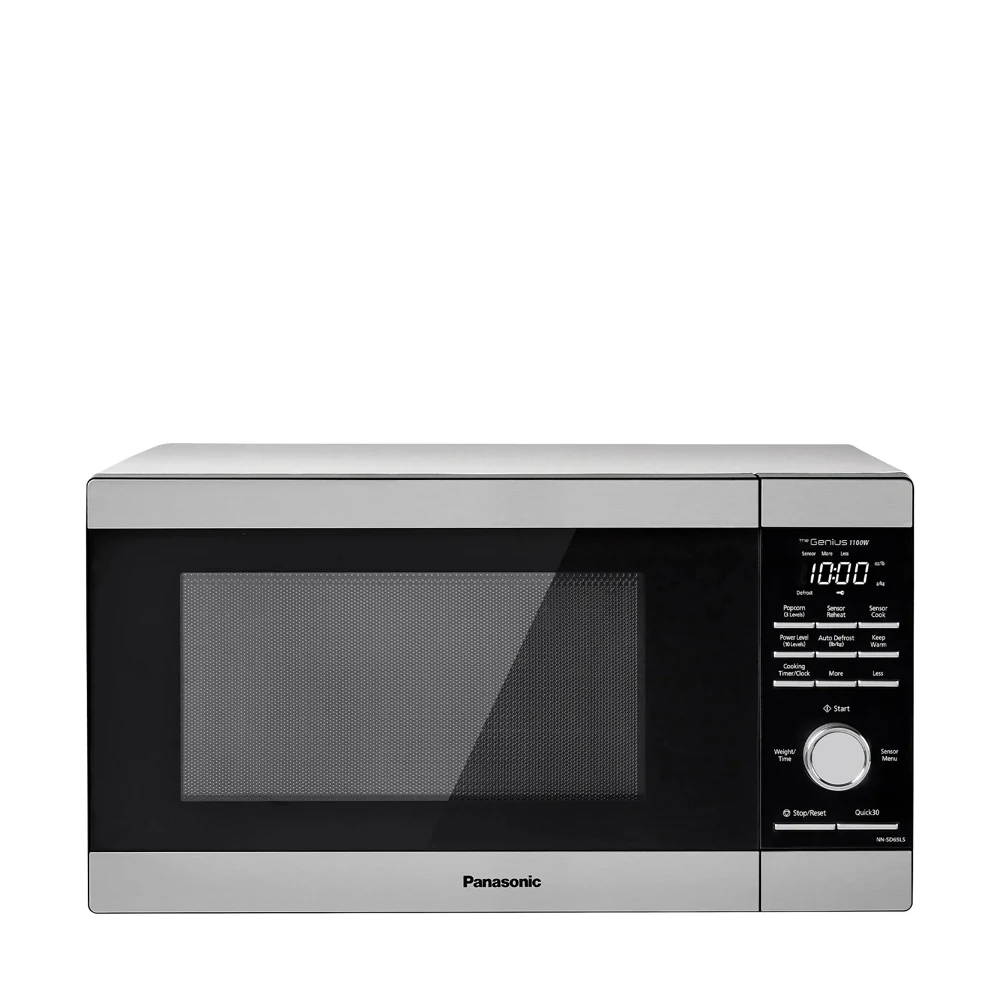
Explore this need in the finder →The Panasonic NN-SD65LS is a 1.3-cu.-ft.,1,100-W countertop microwave for someone who wants sensor reheating and a dial-based control routine. Its strongest distinction is that combination of everyday meal capacity and controls. Its ventilation requirement is easy to overlook: the documented4-inch gaps make the operating space appreciably larger than the body.
Why the controls may matter more than another preset
A microwave is used in short, repeated interactions. If you prefer turning a dial to set time or select a menu, that can be a more meaningful difference than a small increase in cooking output. The NN-SD65LS manual identifies a Start/Weight/Time/Sensor Menu dial alongside dedicated buttons for sensor functions, power and defrost.
This does not make it a one-knob mechanical oven. You still select functions, read the display and confirm operations. It may suit someone who dislikes a numeric pad but is comfortable with a digital menu. If the main user's priority is direct entry of a precise number, compare a keypad model instead. Consider the actual labels and knob grip at the height where the oven will stand.
Quick30 is available for short manual tasks, with Start performed through the dial. The manual also describes limitations on adding time during automatic programs. That distinction matters if your usual habit is to keep adding half a minute regardless of which function is running. Learn the routine for the task you do most often rather than assuming every button behaves like your old microwave.
A mid-size cavity, with a less compact operating envelope
Panasonic gives the body as 21 7/32 inches wide,11 13/16 inches high and17 7/16 inches deep. Those numbers may look manageable in an ordinary kitchen, but the manual calls for4 inches between the oven and adjacent surfaces at the top, sides and rear. The body footprint alone therefore understates the counter allocation.
Adding the documented gaps gives29 7/32 inches of width and15 13/16 inches of height, with21 7/16 inches from the closed-door body front to the rear adjacent surface. Those are simple placement calculations, not a cabinet cutout or a guarantee of front access. Door movement, cord arrangement and the front setback still require attention.
The 12.4-inch turntable is relevant to circular dishes, but it is not a verified maximum plate size. A handled container or square dish may strike the walls while rotating. Use the shape of the dishes you regularly heat to decide whether this1.3-cu.-ft. category is sufficient. A larger nominal cavity is not automatically worth it if your dishes already fit and the extra body would crowd the kitchen.
Sensor reheating for cooked meals
Genius Sensor Reheat uses humidity information rather than only a serving-count timer in the reviewed manual. It fits a routine centered on reheating cooked refrigerated meals, especially when estimating the first time setting is your least favorite part. Sensor Cook provides separate food-category choices.
The sensor still expects the right preparation. The cavity, tray and outside of the container must be dry as directed. Use a suitable cover and follow portion instructions. Do not transfer the reheat procedure to drinks, pastry, raw food or frozen food simply because the button says “Sensor.” Those are different tasks.
For a mixed dinner, arrangement and standing time remain useful. A dense piece beside a light vegetable does not become uniform just because a sensor chooses a time. If your usual food needs a little more or less heating, the model provides an adjustment, but an automatic program cannot prove the food is done to your preference without checking the result.
Keep the power claims precise
The output rating is 1,100 W. The manual separately lists 1,500 W,13 A input at 120 V,60 Hz and requires the documented grounded circuit arrangement. Output helps interpret cooking directions; input is relevant to electrical demand. The larger figure is not additional cooking power.
Importantly, the exact product and manual material reviewed here does not establish Panasonic Inverter Technology for this model. Sensor reheating and inverter control are separate features. If verified inverter operation is essential in the finder, do not select the NN-SD65LS solely because it is a Panasonic or has a dial.
The online product summary and shared manual are not consistent about the number of power levels and menu entries. The manual's operation section explicitly describes P10 downward and a dial procedure, while the product summary gives a shorter count. Rather than base the purchase on a menu total, check the actual controls and the functions your meal routine requires.
Installation and features that remain unconfirmed
This review treats the SD65LS as an open-counter household microwave. No exact approved trim-kit route has been established. Do not install it inside a close-fitting cabinet using a frame intended for a similarly named model. The4-inch clearance instruction is particularly important when looking at a shelf or alcove.
Likewise, a mute procedure and a physical hot-food door lock are not confirmed for every SD65LS edition from the material reviewed. A keypad child-lock label does not settle the door behavior. If either requirement is essential, ask for the actual model's operating instructions and control demonstration before choosing it.
Should it be on your shortlist?
Yes, when dial controls, sensor reheating and ordinary plated meals are the priorities, and you have the full documented operating space. Compare another model if verified inverter control, a confirmed mute setting or an approved cabinet kit is essential. A smaller-body microwave with different clearance instructions may be a better fit for a genuinely narrow space, even when its capacity looks similar.
The NN-SD65LS should be judged by the routine it makes comfortable: selecting the function, turning the dial, loading your normal dish and removing the meal. That is a more useful buying test than the largest feature count in a product title.
Sources
Key details at a glance
| Nominal cavity | 1.3 cu. ft. |
|---|---|
| Cooking output | 1100 W |
| Turntable diameter | 12.4 in |
| Sensor reheating | Documented |
| Body W × D × H | 21.2188 × 17.4375 × 11.8125 in; ventilation additional |
Facts apply to the reviewed model and document edition. Read the relevant section for generation differences and installation conditions.
Sources for this assessment
Compare it with your other choices
Use your needs to find alternatives and understand the tradeoffs.