
Your needs, this model
Does it fit your priorities?
Is this a good white microwave for leftovers?
The 651W has steam-based Sensor Reheat and less body depth than the large SN960S. Check your actual dishes and ventilation space.
Explore this need in the finder →Can I install it with the kit printed in the shared manual?
That trim table applies to 661S/671S. It does not approve built-in installation of the 651W.
Explore this need in the finder →Can it guarantee beep-free use?
A mute procedure was not verified for the reviewed edition. Choose a model with exact documented support if it is essential.
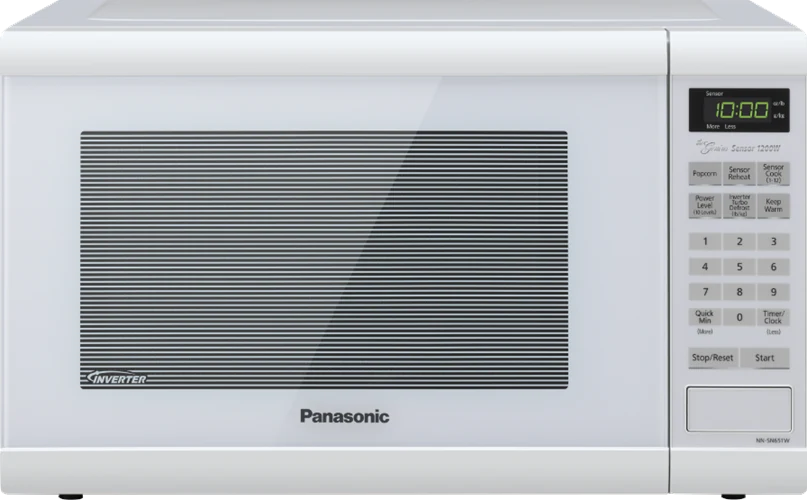
Explore this need in the finder →The white Panasonic NN-SN651W is an earlier 1.2-cu.-ft. inverter model for someone who wants sensor reheating without a family-size cabinet. Its 1,200-W output and numeric controls give it a substantial cooking specification for its body size. Choose it for a countertop routine built around ordinary meals; do not choose it as a trim-kit equivalent of the related stainless models.
A practical middle size for everyday meals
The attraction of this format is balance. A very small oven can become frustrating when a dinner plate barely clears the wall, while a large 2.2-cu.-ft. unit can take away valuable preparation space. The NN-SN651W occupies the middle ground. Panasonic's authorized catalog identifies it as a white, 1.2-cu.-ft. countertop model, and the exact manual provides dimensions rather than leaving you to estimate from a photograph.
The body measures 20 11/16 inches wide, 12 1/4 inches high and 15 13/16 inches deep. Compare that with the clear countertop you can actually spare, not the entire length of a worktop shared with a kettle or toaster. A power outlet, ventilation gaps and a place to set down a hot dish are all part of a workable arrangement.
There is also a difference between capacity and dish fit. The manual gives the cavity as 13 15/16 inches wide, 9 15/16 inches high and 14 3/8 inches deep. A container that fits across the cavity may still collide while turning, especially if it has handles. Use your most awkward everyday dish as the test case, and check the physical opening and rotation path of the unit you are considering.
Sensor reheating is useful for the right leftovers
This model has actual steam-based Sensor Reheat and Sensor Cook in the exact operating manual. That makes it a reasonable candidate when your answer to “What do you heat most often?” is cooked refrigerated meals. It reduces the need to choose an initial time for supported food, which can be helpful when portions vary from day to day.
It is not the same as putting anything inside and expecting the oven to recognize it. Panasonic's reheat instructions exclude beverages, raw food, frozen food and pastries from that particular function. Someone who mainly warms coffee or softens a small ingredient should judge the manual controls first. The automatic menu list is secondary for that routine.
The sensor process also rewards consistency: use the appropriate vented cover, begin with the exterior of the container and cavity dry, and avoid letting steam escape before the sensing stage is complete. Stir or rearrange when the instructions call for it, then allow the food to stand. Those steps help translate the feature into a useful habit rather than a button pressed without regard to the food.
What 1,200 W means in a small kitchen
Panasonic rates the NN-SN651W at 1,200 W cooking output. It separately lists 1,480 W and 12.4 A consumption on a 120-V, 60-Hz supply. Cooking output is relevant to the time printed on food packaging; it is not the electrical load you should use to decide whether a crowded circuit is suitable.
If you are moving from a lower-powered microwave, your familiar full-power timings may overshoot. Keep a short record of the portion and setting that works for your usual food. For delicate heating, use a reduced setting instead of treating the higher output as a reason to run every task at maximum power. Inverter technology is part of that control approach, not proof that every meal comes out evenly without stirring.
The panel combines number pads with dedicated Sensor Reheat, Sensor Cook, Keep Warm and Turbo Defrost functions. Quick Min can be convenient for a familiar short task. It still requires you to understand which function you selected and when Start is needed. If an older relative will be the main user, the readability and feel of the actual keypad may matter more than the long feature list.
The white version has an important installation distinction
The shared manual covers NN-SN651B, NN-SN651W, NN-SN661S and NN-SN671S. It is tempting to treat these as interchangeable installation choices. They are not: its trim-kit specification expressly applies to NN-SN661S and NN-SN671S, while the NN-SN651W is not intended for built-in operation. A kit mentioned at the end of a shared manual does not automatically approve every model named on the cover.
For a white countertop replacement, that distinction may not matter at all. For a cabinet renovation, it is decisive. Start with a model and exact kit that have a documented installation path rather than trying to adapt the NN-SN651W to preserve a finish preference. Do not enclose a countertop oven simply because its body fits the opening.
Controls, sound and an older unit's condition
The reviewed manual documents a keypad child lock. It does not physically lock the door, and the pictured earlier controls should not be confused with later hot-food door-lock systems. A buyer who needs a specific release sequence should check the actual appliance rather than transferring a feature from a newer Panasonic.
A verified mute procedure has not been established for this exact reviewed edition. Beep-free operation therefore should not be a promised benefit. For early-morning use, consider whether the door action and fan would still disturb someone even on another model that has a mute setting.
Because this is earlier documentation, an offered example deserves a condition check. Confirm the full model label, correct tray and roller, intact door and matching manual. Do not assume that a historical product page tells you the warranty or condition of the seller's unit.
Our buying view
Shortlist the NN-SN651W if white finish, ordinary dinner-sized meals and sensor reheating matter, and an earlier countertop model is acceptable. Choose a smaller format if you mainly heat cups and small bowls. Choose a different documented installation model if built-in use is essential. Its strongest case is a practical everyday meal routine in a kitchen where a large microwave would consume too much working space.
Sources
- Panasonic exact-family operating manual
- Panasonic authorized NN-SN651W catalog
- Panasonic model-specific reheating instructions
Key details at a glance
| Nominal cavity | 1.2 cu. ft. |
|---|---|
| Cooking output | 1200 W |
| Sensor reheating | Documented |
| Inverter power control | Documented |
| Approved trim-kit route | Not supported in reviewed instructions |
| Body W × D × H | 20.6875 × 15.8125 × 12.25 in; ventilation additional |
Facts apply to the reviewed model and document edition. Read the relevant section for generation differences and installation conditions.
Sources for this assessment
Compare it with your other choices
Use your needs to find alternatives and understand the tradeoffs.