
Your needs, this model
Does it fit your priorities?
Does it match a sensor-reheating shortlist for everyday leftovers?
Yes, for the suitable precooked foods described in its manual. The actual steam-sensing instructions, dry-container preparation and covering requirements matter more than choosing a Reheat label alone.
Explore this need in the finder →Can I require inverter power control and a beep-off choice?
Both are documented for the reviewed model. The beep choice is made in initial setup; inverter power control remains separate from automatic sensing and is not a measured cooking-uniformity score.
Explore this need in the finder →Can it replace an oven behind my existing trim frame?
The original manuals name an optional NN-TK621S route. Match the unit, actual kit instructions and opening before choosing; a frame that merely looks similar is insufficient.
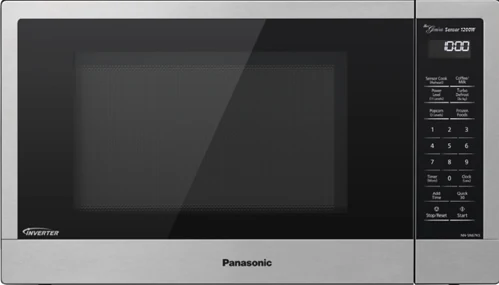
Explore this need in the finder →The Panasonic NN-SN67KS suits a kitchen where reheating a covered dinner plate or bowl is the main job. Its 1.2-cu.-ft. cavity, 1,200-W cooking output and steam-sensing programs offer a useful middle ground between a tiny microwave and a large combination oven. The most important choices are whether your dishes rotate comfortably, whether its counter clearances work, and whether you like the updated door-opening routine. This assessment is based on Panasonic's operating instructions and parts information; it does not report test-kitchen results.
Measure the dish as well as the counter
The body measures 20 11/16 inches wide, 15 13/16 inches deep and 12 1/4 inches high. Panasonic asks for three inches of air space at each side and one inch above. That means roughly 26 11/16 inches of width including the side gaps. Keep the rear stopper in place and position the door front at least three inches back from the counter edge. An opening that merely accommodates the metal cabinet is not enough.
The manual lists a cavity about 13 15/16 inches wide, 14 3/8 inches deep and 9 15/16 inches high. The specified replacement glass tray is listed at 13 1/2 inches by Panasonic's parts supplier. That is a planning reference, not a guaranteed maximum plate size. Check a wide dinner plate with its cover, and a rectangular container with its handles: the full outline must clear the walls as it rotates. Cavity height also differs from the usable doorway opening.
Sensor reheat is useful for a defined kind of meal
Sensor Reheat detects steam, then displays the remaining cooking time. Its documented range is 4–16 ounces of precooked food starting at refrigerator or room temperature. That makes a covered plate of leftovers, soup or a modest casserole portion a natural use. A tiny snack, frozen dinner or mug of coffee calls for another approach; the panel provides separate Frozen Foods and Coffee/Milk choices, plus manual time and power.
The sensor needs a little cooperation. Dry the cavity, tray and outside of the dish, use the recommended vented cover, and keep the door closed until the remaining time appears. You can then stir or rearrange the food. Standing time still matters afterward. More/Less adjustments let you alter the sensor result to preference, but this remains a cooking aid rather than a measurement of the temperature at the center of your meal.
Enough control for everyday reheating
Panasonic explicitly identifies Inverter technology in the model's manual. The controls offer P10 through P1, plus P0 Keep Warm, rather than asking you to heat everything at maximum power. This is useful when a small portion or dense dish needs gentler treatment. The 1,200-W figure describes microwave cooking output; the electrical specification separately lists 1,480 W and 12.4 A.
Quick 30 builds a time in half-minute steps, up to five minutes, and you then press Start. It can also extend manual cooking. This is a straightforward routine for someone who usually knows approximately how long their food needs. Up to three manual cooking stages are available, while automatic programs have separate restrictions. Turbo Defrost accepts food weight, with turning and rearranging still part of the process. None of these controls establishes a measured advantage in heating speed or evenness.
The updated door adds a deliberate extra step
In the 2024 instructions, the door lock engages when cooking begins. To open during or after cooking, press the number pad marked 0 Door Open, then press the physical door-release button within ten seconds. Opening to stir therefore involves a keypad action before the release. Try that sequence if reach, grip or remembering an extra step could affect daily use; the booklet cannot tell you how easy the button will feel in your kitchen.
The door-lock instructions provide a way to deactivate and reactivate that feature. It is separate from the keypad child lock, which prevents electronic operation. An older booklet describes the keypad lock without this added door-lock procedure. That distinction is worth understanding before expecting a single release-button press to open every NN-SN67KS you encounter.
Beep control helps in a shared living space
The oven offers Beep On and Beep Off during the initial plug-in setup. You reach the sound choice through Start and Timer (More), then confirm with Stop/Reset. It is a setup preference rather than a dedicated mute pad. For early breakfasts or late reheating, switching off the beeps may be more useful than collecting additional food presets. With audible prompts off, watch the display for the sensor countdown and completion.
Beep control does not silence the fan, turntable or physical door mechanism. No sound-level measurement supports calling this a particularly quiet microwave. Keeping the roller ring and cavity floor clean is part of avoiding unnecessary tray noise; the removable glass tray and roller ring can be washed as the manual directs, including in a dishwasher.
Make one model-and-panel check before ordering
Ask for the actual rating label and front-panel photograph, then match the supplied booklet to that appliance. This review concerns NN-SN67KS at 1,200 W. A 1,100-W claim or a listing written NN-SN67KS2 should prompt a label check before accepting it as equivalent. Look for the 0 Door Open marking when checking the updated door workflow. A manual's publication year alone does not establish when every retail unit changed.
For installation, the current instructions specify household use, 120 V/60 Hz and a separate grounded circuit with at least a 20-A outlet. An optional NN-TK621S trim kit is named, with its own installation requirements. Choose the NN-SN67KS when ordinary plates, sensor-assisted leftovers and adjustable alerts fit your routine. Oversized serving dishes and door-operation preferences deserve more attention than the capacity label alone.
Key details at a glance
| Nominal cavity | 1.2 cu. ft. |
|---|---|
| Cooking output | 1200 W |
| Sensor reheating | Documented |
| Inverter power control | Documented |
| Alert mute setting | Documented |
| Approved trim-kit route | Documented |
| Body W × D × H | 20.6875 × 15.8125 × 12.25 in; ventilation additional |
Facts apply to the reviewed model and document edition. Read the relevant section for generation differences and installation conditions.
Sources for this assessment
Compare it with your other choices
Use your needs to find alternatives and understand the tradeoffs.