
Your needs, this model
Does it fit your priorities?
Does choosing1.6cuft automatically save counter depth?
No. The SN76LS body is 19 7/16 inches deep, like several larger Panasonic models. It mainly saves width and height.
Explore this need in the finder →Will it suit ordinary plated meals with automatic reheating?
Its documented sensor programs and inverter power suit that routine when your dishes and installation fit.
Explore this need in the finder →Can it be part of a cabinet installation?
The exact US trim finder lists multiple kit options for SN76LS. Match the full kit and cutout instructions before buying.
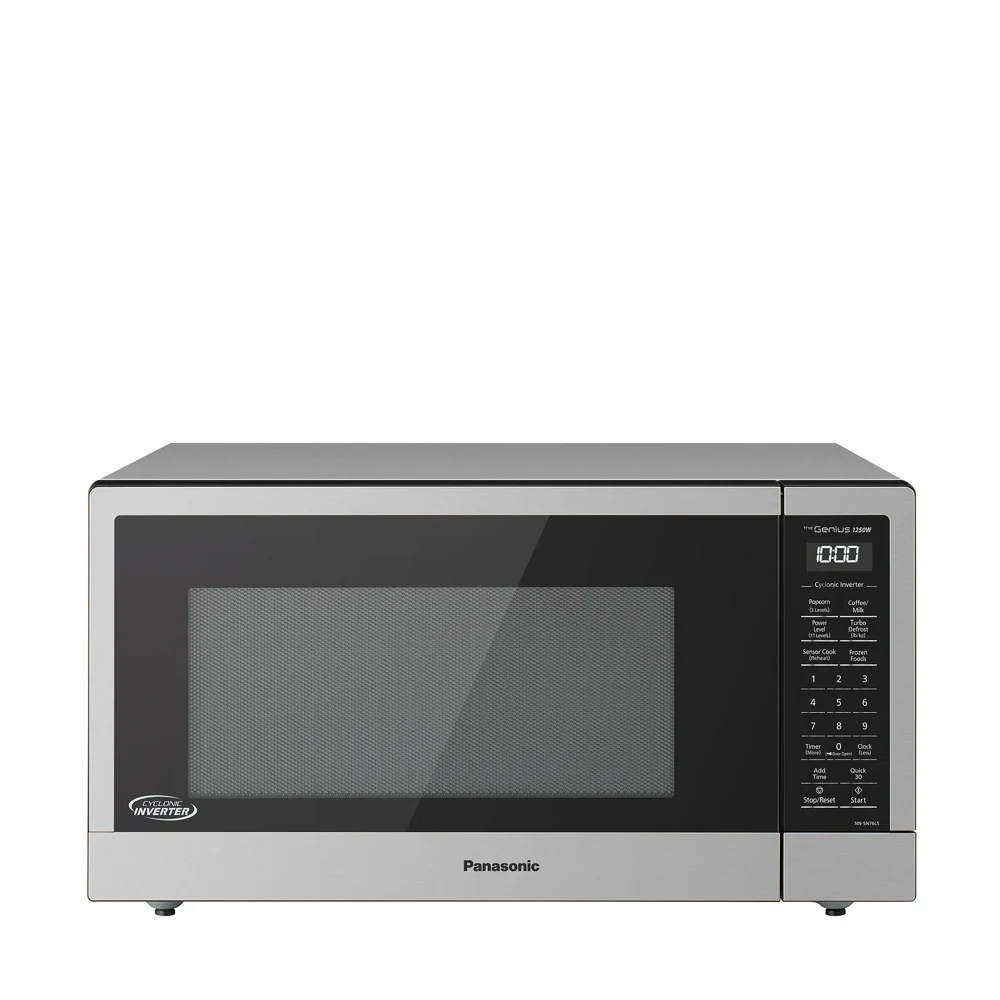
Explore this need in the finder →The Panasonic NN-SN76LS is a 1.6-cu.-ft.,1,250-W Cyclonic Wave inverter microwave for buyers who want a meal-sized cavity and sensor control without moving to the widest family format. Its strength is the combination of medium-large capacity, numeric input and a documented kit-installation route. Its most easily missed compromise is depth: this is not a shallow-counter microwave.
A medium capacity does not mean a small footprint in every direction
Panasonic gives the SN76LS body as 21 7/8 inches wide,11 15/16 inches high and 19 7/16 inches deep. It saves width and height compared with a 2.2-cu.-ft. Panasonic, but some of those larger models have the same quoted body depth. If the counter is shallow, moving down a capacity class may not solve the problem.
Before choosing, identify which dimension is actually restrictive. A narrow gap, a low shelf and a shallow worktop are different situations. Then add the ventilation and access required by the exact installation instructions. The outside dimensions do not include all the space needed to operate the oven comfortably.
A medium-large cavity can be a good compromise for ordinary dinner plates and covered bowls. It should not be treated as proof that any casserole fits. Measure the complete dish with its handles and lid, then check the opening and rotation path. The nominal1.6-cu.-ft. volume describes a cavity category rather than a maximum usable dish shape. The manual gives the cavity as 15 11/16 inches wide and 8 1/4 inches high, with 18 1/2 inches of depth; a tall covered bowl deserves particular attention.
When Cyclonic Wave inverter control is useful
Cyclonic Wave is Panasonic's documented microwave-energy system for this model, alongside inverter power control. It is relevant if you want a choice of reduced-power routines as well as fast full-power heating. It is not a hot-air or convection mode, and it does not establish that a reheated pizza will brown.
The output rating is 1,250 W. When replacing a lower-output microwave, check cooking directions rather than automatically repeating old timings. A sauce, a dense dish and a small snack can respond differently. Learning a short, controlled routine for your usual portion is more useful than assuming the highest setting is always the most efficient choice.
There is no hands-on temperature comparison in this review. Food arrangement, stirring and standing time can still matter. A documented inverter feature should not be turned into a promise that every meal heats uniformly regardless of its shape, density or container.
Sensor routines for a mixed meal schedule
The model's sensor programs are a good reason to consider it for a household that frequently reheats cooked meals. Instead of estimating time for every plate, you follow the supported program for that food. Panasonic also documents separate frozen-food and other cooking routines, so not every task needs to be forced into Sensor Reheat.
For the sensor to be useful, the food, quantity and cover must match the instructions. Keep the relevant surfaces dry and respect the sensing stage before opening the door. A mug, pastry and chilled mixed plate do not generate the same information and are not interchangeable reheating jobs.
If you know a reliable manual setting for the same lunch each day, use it. If portions vary, sensor control can reduce the starting guess. Either way, check the food and use the instructed standing time. The value is a more comfortable routine, not an automatic guarantee of the precise texture you prefer.
Number pads and an optional muted-alert routine
The SN76LS uses numeric timing controls, which is useful for someone who likes entering a known time directly. Dedicated functions and a quick-time shortcut support other tasks. A person whose essential preference is a dial should compare a dial-equipped model rather than expecting all Panasonic controls to feel alike.
Panasonic's model-specific sound guidance includes the SN76 family and documents Beep Off. That can make electronic alerts less intrusive during an early breakfast. The fan, rotating mechanism and door remain separate sources of sound. A mute setting should not be interpreted as a measured quiet-operation result.
Door behavior needs a separate check. The current product page promotes an automatic child-safety door lock, while the older family manual describes earlier electronic controls. Confirm the actual edition and matching release instructions, especially if reduced dexterity or one-handed use is important. The phrase “child lock” by itself does not identify a physical opening sequence.
A cabinet installation needs the exact kit
Panasonic's US trim finder explicitly lists multiple kit options for the NN-SN76LS. That gives it a documented installation route beyond sitting on an open counter. A compatible kit is still a separate component unless a seller expressly includes the named parts in the offer.
Do not choose a kit solely because it is advertised for a 1.6-cu.-ft. Panasonic. The opening, duct pieces and ventilation arrangement must match the exact model and kit. The manual specifically distinguishes flat 72L/73L trim for a cabinet with a back vent opening from vented 722/732 trim that supports either listed cabinet type. The appearance of the frame is not enough to choose the ventilation arrangement.
For an existing cabinet, measure the true opening behind the old trim. Check the support surface and electrical access before deciding that another oven with a similar face will replace it. For countertop placement, follow the exact clearance directions instead of applying cabinet-kit measurements to an open-counter setup.
Our shortlist view
The SN76LS makes sense when ordinary meal capacity, sensor reheating, inverter control and numeric entry are the priorities. It is less compelling if saving body depth is the main problem or if you need browning in the same appliance. Compare the smaller SN68KS for a shallower body, and compare a combination oven for baked or crisped food. Establish the actual unit's edition and accessories before buying: a good fit is a match between the kitchen, the dishes and the control routine, not simply a higher capacity.
Sources
- Panasonic US SN76LS product page
- Exact-family original owner manual
- Panasonic exact-model support guide
- US model-specific trim finder
- Panasonic sound settings
Key details at a glance
| Nominal cavity | 1.6 cu. ft. |
|---|---|
| Cooking output | 1250 W |
| Sensor reheating | Documented |
| Inverter power control | Documented |
| Alert mute setting | Documented |
| Approved trim-kit route | Documented |
| Body W × D × H | 21.875 × 19.4375 × 11.9375 in; ventilation additional |
Facts apply to the reviewed model and document edition. Read the relevant section for generation differences and installation conditions.
Sources for this assessment
Compare it with your other choices
Use your needs to find alternatives and understand the tradeoffs.