
Your needs, this model
Does it fit your priorities?
Is it a useful step up from a cramped compact microwave?
Its 1.6-cu.-ft. format is relevant to ordinary plates, but the body remains over 19 inches deep. Check the exact edition and your dish.
Explore this need in the finder →Can I mute the electronic beeps?
Both reviewed family manuals document Beep Off. This does not silence the fan, tray or door.
Explore this need in the finder →Will a bowl fit equally well in every NN-SN77HS?
The newer manual gives a smaller cavity despite the same outer body. Include the lid when checking your bowl against the actual unit.
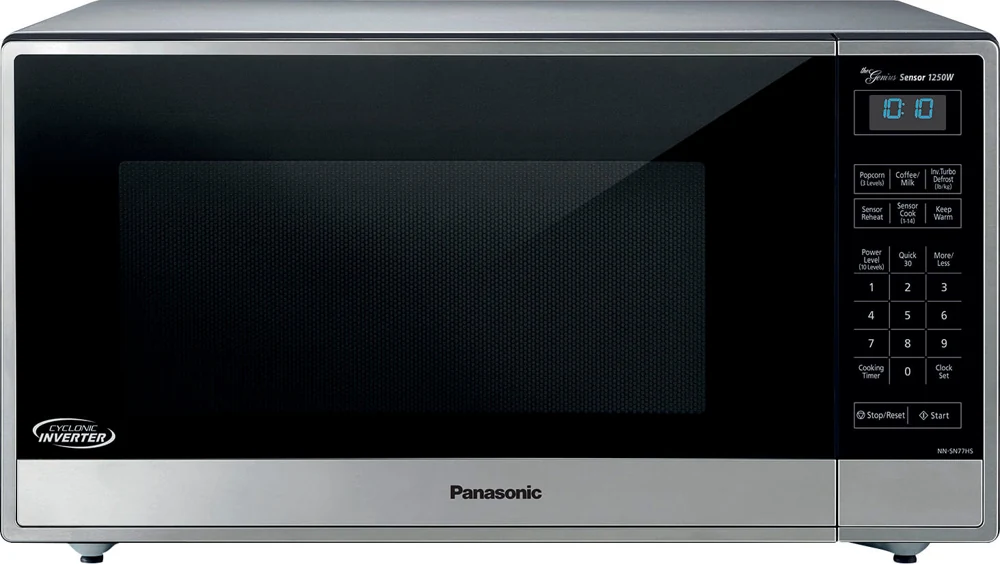
Explore this need in the finder →The Panasonic NN-SN77HS is worth considering when a 1.2-cu.-ft. microwave feels restrictive but a wide 2.2-cu.-ft. model would dominate the counter. Its 1.6-cu.-ft. format combines 1,250-W cooking output with Cyclonic Inverter and sensor reheating. The important buying checks are its substantial depth, the exact control edition and the correct trim kit if you plan to install it in cabinetry.
The useful middle ground is about shape
A medium-to-large cavity is appealing when your everyday plate is the problem, rather than the need to heat several dishes at once. The NN-SN77HS can make sense for a couple or family heating ordinary meals in succession. It is less compelling for a mug-only routine, where preserving a clear preparation area may be more useful than extra cavity volume.
Panasonic lists the body at 21 7/8 inches wide, 11 15/16 inches high and 19 7/16 inches deep. That last measurement matters: choosing a body that is narrower than a family-size model does not necessarily save the same amount of front-to-back counter space. Lay out the footprint with tape, then add the ventilation and access required by the matching manual.
The earlier manual gives a cavity 16 7/16 inches wide and 9 inches high; the newer official manual gives 15 11/16 inches wide and 8 1/4 inches high, with the same 18 1/2-inch depth. The body dimensions remain the same. This is a meaningful edition difference when a particular dish is the reason for buying. For a tall covered bowl, check the lid and handles. For a rectangular casserole, check the turning path and opening, not simply whether its longest side is shorter than the cavity width. Neither a capacity label nor a tray measurement is a guaranteed dish-fit certificate.
Where sensor reheating earns its place
If leftovers are the main task, Sensor Reheat is a more relevant convenience than a long menu list. It provides an automatic approach for the supported cooked foods rather than making you estimate the starting time. The family manual also documents Sensor Cook, Turbo Defrost and Keep Warm, so there are separate routines for different jobs.
Think of the sensor as part of a defined food-and-container procedure. Dry the outside of the container and cavity, use the specified covering method and follow the food restrictions. If you mainly heat drinks or tiny snacks, those habits and programs may be less useful than a simple manual setting. Automatic cooking still depends on food arrangement and checking the result.
Cyclonic Inverter is Panasonic's name for this model family's microwave power system. It is not a measured comparison proving that every cold spot disappears. Dense food, irregular shapes and mixed plates can still benefit from stirring, rearranging and standing time. The useful reason to shortlist it is the documented control and convenience, not an unsupported promise of flawless cooking.
Power for meals, with attention to familiar timings
The documented cooking output is 1,250 W. The earlier exact-family manual separately lists 1,460 W and 12.3 A input on a 120-V, 60-Hz supply. The output figure helps interpret recipe timings; electrical installation depends on the input and circuit instructions. They should not be substituted for each other.
When moving from a lower-powered oven, learn a setting for your regular portion instead of automatically repeating the old full-power time. A short task can overshoot before you notice, especially for food that continues heating while it stands. Reduced-power cooking is useful when control matters more than saving a few seconds.
For a user who cooks from package instructions, compare the output requirement on the package and follow its adjustment guidance. For a user who improvises, dedicated sensor and defrost programs can provide a structured starting point. In either case, the display and keypad must be comfortable to read and operate in the actual kitchen lighting.
Check the control edition before relying on a door feature
There are earlier and newer official manuals for this family. The existence of a newer document does not tell you which controls a seller's unit has or establish a production-date boundary. The newer manual documents pressing 0 before the physical door release to unlock during or after cooking. A picture of an older panel cannot prove that sequence applies. Inspect the panel, full model label and manual supplied with the actual appliance.
Keep keypad child lock separate from a physical door-release system. The former stops operation of the controls; it does not, by itself, establish that the door stays shut after cooking. If one-handed access, reduced dexterity or controlling access to hot food is a major requirement, an exact demonstration of the unit's release sequence matters more than the general “child safety” label.
Both reviewed family manuals document an initial Beep Off choice. This makes the model relevant when electronic alerts are unwelcome in an early-morning kitchen. It does not silence the fan, tray or door, and it is not a measured quiet-operation result.
A documented cabinet route still requires the right parts
The earlier NN-SN77HS manual identifies 27-inch NN-TK722S and 30-inch NN-TK732S trim options. Panasonic's finder uses longer SS-suffixed kit codes for relevant models. This is a reason to confirm the exact compatibility chain, not to buy whichever trim panel looks close enough.
The advertised cabinet size describes the trim format rather than the microwave body's required opening. A complete installation involves the correct kit, cutout, ventilation and electrical arrangement. Keep the kitchen countertop plan and the kit installation plan separate. If your cabinet opening is fixed, resolve those measurements before choosing the oven.
Who should choose another format?
Choose a compact model if saving depth is the priority; this body still reaches more than 19 inches before the rest of the installation is considered. Choose a larger cavity only when your dishes justify it. Choose a combination microwave if you need browning or baking: this is a microwave cooking choice, not a substitute for convection or an air fryer.
The NN-SN77HS is strongest as a mid-large meal reheater for a household that values sensor control and has checked its physical space. An exact offer still needs a condition, edition and accessory check. The name alone does not establish current stock or that every illustrated feature belongs to the unit in front of you.
Primary references
- Panasonic NN-SN77HS product guide
- Earlier NN-SN77HS/97HS manual
- Newer official family manual
- Panasonic dimension comparison
Key details at a glance
| Nominal cavity | 1.6 cu. ft. |
|---|---|
| Cooking output | 1250 W |
| Sensor reheating | Documented |
| Inverter power control | Documented |
| Alert mute setting | Documented |
| Approved trim-kit route | Documented |
| Body W × D × H | 21.875 × 19.4375 × 11.9375 in; ventilation additional |
Facts apply to the reviewed model and document edition. Read the relevant section for generation differences and installation conditions.
Sources for this assessment
Compare it with your other choices
Use your needs to find alternatives and understand the tradeoffs.