
Your needs, this model
Does it fit your priorities?
Does it make sense for reheating large dinner plates?
The large cavity and steam-based Sensor Reheat suit that routine. Confirm dish rotation and follow the program restrictions.
Explore this need in the finder →Will it fit a counter gap just 24 inches wide?
The 23 7/8-inch body is not the required operating width. The manual adds 3 inches on both sides.
Explore this need in the finder →Does its child lock keep the door shut?
The reviewed earlier edition disables electronic operation rather than locking the physical door.
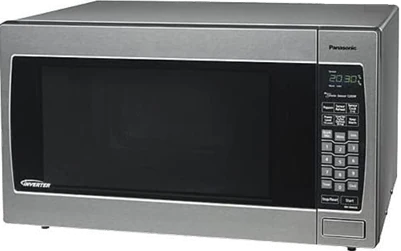
Explore this need in the finder →The Panasonic NN-SN960S is a large earlier-generation sensor microwave worth understanding if you already own one or are comparing an older-stock example. Its 2.2-cu.-ft. family size and 1,250-W output suit substantial plated meals. The main compromise is its wide, deep body; the unresolved cabinet-installation wording also makes it a poor choice for an assumed drop-in built-in replacement.
Choose it for the dishes, not just the capacity number
A roomy microwave helps when the problem is a dinner plate that crowds a smaller cavity or an awkward covered bowl. It brings less value to someone whose routine is a cup of coffee and a small lunch container. Before choosing this category, lay out the dishes you use over an ordinary week. Include the lid and handles, not just the diameter printed on the base.
Panasonic's family chart lists the NN-SN960 at 2.2 cu. ft., and its body and cavity measurements agree with the exact NN-SN960S manual. The cavity measures 18 7/16 inches wide, 10 15/16 inches high and 18 1/2 inches deep. That is useful comparative information, not a promise that every rectangular container fitting those limits will turn. The door opening and the rotating path can be the tighter constraints.
If you are replacing an existing NN-SN960S, measure the opening and the old unit separately. A slightly newer model with a similar name can have different ventilation instructions, controls or trim parts. Replacement shopping is easier when you bring the full model label and your dish measurements rather than just asking for another 2.2-cu.-ft. Panasonic.
How it changes a reheating routine
The exact manual documents Genius Sensor Reheat and Sensor Cook. For the right household, the benefit is less guessing for a covered plate of cooked refrigerated food. The oven waits for a steam-related signal before presenting the remaining time. It does not inspect every ingredient or guarantee that a dense center has reached a particular temperature.
Its usefulness depends on using the intended process. Keep the cavity and outside of the container dry, choose a suitable cover and follow the model's portion restrictions. Panasonic specifically excludes beverages, frozen food, pastry and raw food from Sensor Reheat. That makes it a good match for a leftovers-centered routine, but less compelling if most of your microwave use falls into those excluded categories.
After cooking, allow the instructed standing time and check the actual meal. A plate containing a dense portion beside a light vegetable still benefits from sensible arrangement and stirring where practical. If you prefer a predictable manual sequence for the same lunch every day, there is no need to force that task into an automatic program.
Power matters when transferring familiar timings
The exact specification is 1,250 W cooking output, with separate input consumption of 1,460 W and 12.7 A on 120 V, 60 Hz. Those figures answer different questions. Output helps you interpret recipe and package timings; input and the installation instructions determine the electrical arrangement. Do not select an outlet or extension arrangement from the cooking wattage alone.
Moving from a lower-output microwave can require shorter heating or a reduced setting for familiar food. The better approach is to build a new routine for your usual portion, checking before a delicate food overshoots. Full power is only one tool. The inverter system, weight-based defrost and manual power selection give you alternatives when the aim is controlled heating rather than maximum speed.
Panasonic also documents Quick Min, Keep Warm and programmed standing time. Those functions are useful for someone who likes repeatable sequences. They are not interchangeable shortcuts: adding a minute is different from selecting a reduced power level, and a kitchen timer is different from operating the microwave. Read the panel labels carefully when teaching another household member to use the oven.
The body is only the beginning of the space calculation
The NN-SN960S body is 23 7/8 inches wide, 14 inches high and 19 7/16 inches deep. The manual asks for 3 inches at each side and 1 inch above, and positions the door front at least 3 inches back from the counter edge. Consequently, a bare appliance-width gap is not enough for the documented countertop placement.
For a real kitchen, check where a hot plate will land when you take it out. Also consider the user's reach. A large microwave at an awkward height may turn the extra capacity into a lifting problem. Maintain the manufacturer's ventilation conditions rather than using the body dimensions as a shelf cutout.
Why we do not assume a built-in replacement
The exact manual contains two pieces of information that need reconciling: its placement section says the oven is not intended for built-in operation, while the specification page lists NN-TK929SF and NN-TK939SF trim kits. The existence of that kit table should not be treated as a blanket approval for an existing cabinet. Obtain confirmation for the actual model, matching kit and installation instructions before buying it for that purpose.
The older manual also documents an electronic child safety lock, which disables operation without physically locking the door. There is no verified automatic hot-food door-release sequence for this reviewed edition. A buyer with a specific accessibility or child-access requirement should inspect the actual controls. Likewise, we have not established a model-specific mute setting, so silence-sensitive households should not count it as a confirmed fit.
When to keep looking
Panasonic's support guide identifies this family as discontinued. That does not invalidate an owner's appliance, but it changes the buying questions: condition, supplied parts and support for the actual example matter more than an old listing's feature headline. Prefer a smaller microwave if you lack the clear operating space. Prefer a documented current installation package when a cabinet project is the goal. The NN-SN960S makes most sense as a spacious sensor-reheat reference for buyers who accept its age and have checked the exact unit.
Manufacturer references
Key details at a glance
| Nominal cavity | 2.2 cu. ft. |
|---|---|
| Cooking output | 1250 W |
| Sensor reheating | Documented |
| Inverter power control | Documented |
| Body W × D × H | 23.875 × 19.4375 × 14 in; ventilation additional |
Facts apply to the reviewed model and document edition. Read the relevant section for generation differences and installation conditions.
Sources for this assessment
Compare it with your other choices
Use your needs to find alternatives and understand the tradeoffs.