
Your needs, this model
Does it fit your priorities?
Is every 2.2-cu.-ft. Panasonic the same inside?
No. The JS manual gives a different cavity shape from some960S/966S models. Check your complete dish, not just nominal capacity.
Explore this need in the finder →Can it brown food as well as heat it?
No convection, broil or air-fry heating is documented for this microwave. Consider a combination model for browning.
Explore this need in the finder →Is it a candidate for large leftovers and muted alerts?
It has sensor reheating and a documented BeepOff setting. Verify the full operating space and exact unit.
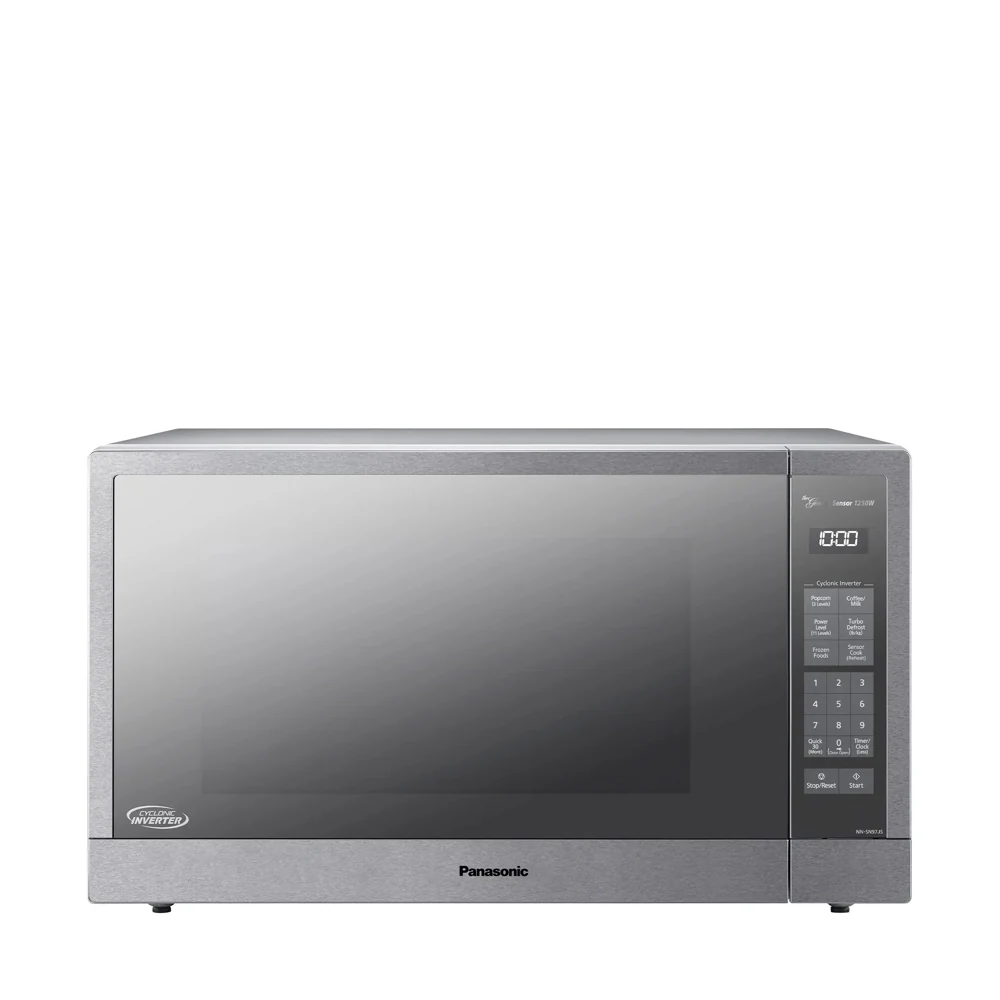
Explore this need in the finder →The Panasonic NN-SN97JS is a 2.2-cu.-ft. Cyclonic Wave inverter microwave for a kitchen where large plated meals justify a substantial counter allocation. It offers 1,250-W output, sensor reheating and numeric controls. Its main limitation is physical size; the exact door-control edition and trim installation also need checking before treating it as a replacement for another Panasonic.
Choose the large format only when your dishes need it
Someone heating a broad plate or a covered serving bowl has a different problem from someone warming a cup. The SN97JS is relevant to the first situation. It is less persuasive when its extra volume would mostly sit unused while the body occupies a preparation area.
The body measures 23 7/8 inches wide, 14 inches high and 19 7/16 inches deep. Add the relevant ventilation and front access rather than using those numbers as the whole space budget. Think through the door swing and the route from the refrigerator to the microwave. A large oven should not make it difficult to set a hot dish down safely.
Panasonic's nominal16.5-inch turntable is helpful comparative information, but a round tray measurement does not guarantee that a rectangular pan fits. Handles, raised lids and corner rotation can be limiting factors. Check your complete container and the loading opening before choosing this capacity for one specific dish.
It is not the same cavity as every other2.2-cu.-ft. Panasonic
The original JS-family manual gives the inside as 17 11/16 inches wide,10 13/16 inches high and 18 1/2 inches deep. Several other Panasonic2.2-cu.-ft. models have different published cavity dimensions despite similar outside bodies. A familiar capacity label does not prove that the inside is the same shape.
This matters most when replacing an existing oven. Your ordinary plate may fit both models, yet a tall covered bowl could be more awkward in one. Record the dimensions of the container you care about rather than assuming a matching brand and capacity make the change effortless.
The NN-SN97JS is also a different code from NN-SN97HS, NN-SN96JS and NN-SN960S. Do not transfer a door diagram, accessory or kit approval from one to another without an exact reference. A similar model name is a research lead, not a full equivalence statement.
A good reason to want sensor reheating
If your microwave is used for cooked leftovers every day, Sensor Reheat is a concrete convenience. You follow the appropriate food procedure rather than choosing an initial time from memory. The model also has separate frozen-food and beverage routines, so the right function depends on what is actually being heated.
The sensor process requires the food, portion, cover and moisture conditions described in the manual. A very small snack and a dense chilled dinner are not interchangeable. Avoid opening the door before the sensing stage permits it, and use dry surfaces where directed. Those requirements are part of the function, not optional fine print.
A mixed plate can still benefit from stirring or rearrangement and standing time. Check the finished food rather than assuming an automatic cycle measures a safe or preferred temperature at every point. The feature reduces timing effort; it does not eliminate normal cooking judgment.
Power control is useful beyond maximum speed
The cooking-output rating is 1,250 W. The original exact-family manual separately lists1,460 W and 12.3 A input on120 V,60 Hz. Treat the output as the reference for cooking directions and the input as an electrical specification. They answer different questions.
Cyclonic Wave inverter control is relevant when you want to use reduced-power settings deliberately. Delicate reheating, a dense portion or thawing before cooking may benefit from a different approach than a full-power shortcut. It is not convection, and it will not create an oven-browned surface simply because the product page describes circulating energy.
The panel offers direct numeric timing alongside automatic programs and Quick30. That combination suits someone who likes a known manual routine but wants a sensor option when portions vary. A user who requires a rotary dial should compare a documented dial model instead.
Electronic alerts and a changing door arrangement
Panasonic's model-specific guidance confirms a Beep Off choice for the JS family. This can help with an early breakfast or an aversion to completion signals. It leaves fan, tray and door sounds unchanged, and no measured mechanical-noise rating is supplied in this review.
The US product page now highlights an automatic child-safety door lock, while the linked original manual shows earlier electronic-lock controls. Check the label, panel and supplied instructions of the actual unit before depending on a particular release sequence. A keypad lock that prevents operation is different from a physical lock that affects opening after cooking.
For a user with limited dexterity, try to evaluate the whole sequence. An extra button may be manageable in one kitchen and awkward in another. A broad claim that a door lock is easy for everyone is less helpful than knowing exactly what the user has to press and reach.
Cabinet installation and the final decision
The US trim finder names NN-SN97JS among models with multiple kit options, and the original family manual gives a documented trim route. A compatible kit is not automatically included with the oven. Confirm the complete kit code, cabinet opening and installation sheet before reusing a frame or cutting cabinetry.
Choose the SN97JS when large dishes, sensor convenience, inverter control and numeric timing are useful enough to justify its footprint. Choose a smaller body if working space is more valuable than volume. Choose a combination oven when browning is essential. The best purchase is the unit whose exact edition, accessories and physical arrangement fit the meals you actually make.
Primary references
- Panasonic exact US product page
- JS-family owner manual
- Model-specific US trim finder
- Panasonic sound settings
Key details at a glance
| Nominal cavity | 2.2 cu. ft. |
|---|---|
| Cooking output | 1250 W |
| Turntable diameter | 16.5 in |
| Sensor reheating | Documented |
| Inverter power control | Documented |
| Alert mute setting | Documented |
| Approved trim-kit route | Documented |
| Body W × D × H | 23.875 × 19.4375 × 14 in; ventilation additional |
Facts apply to the reviewed model and document edition. Read the relevant section for generation differences and installation conditions.
Sources for this assessment
Compare it with your other choices
Use your needs to find alternatives and understand the tradeoffs.