
Your needs, this model
Does it fit your priorities?
Does saying reheat guarantee humidity-sensor heating?
No. The manual distinguishes the physical one-push sensor from generic voice reheating and contains conflicting food-command details.
Explore this need in the finder →Can I use it without connecting Alexa?
Panasonic documents a physical dial workflow and an option to skip Alexa setup. Connectivity is an optional control choice.
Explore this need in the finder →Can I switch off beeps without Alexa?
The model-specific instructions document Beep Off in manual setup. Fan and door noise are separate.
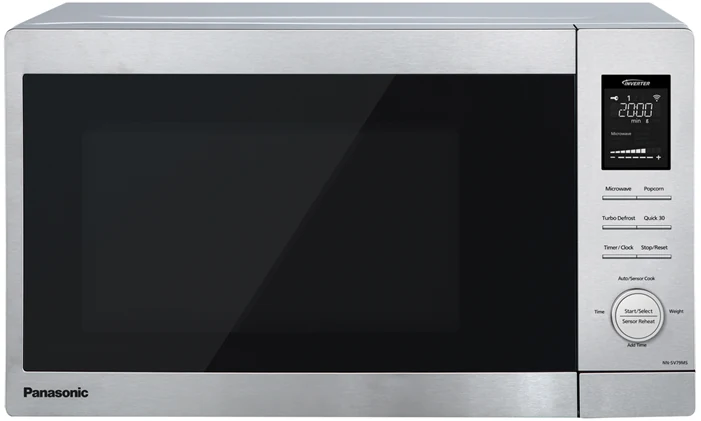
Explore this need in the finder →The Panasonic NN-SV79MS is a 1.4-cu.-ft., 1,200-W inverter microwave for a household that wants both a physical dial and the option of Alexa voice commands. Its real distinction is the connected control choice. Voice heating and the physical one-push humidity-sensor routine must be kept separate; neither the smart label nor a command list proves that every spoken request uses the sensor.
When voice control is worth choosing
If you already use Alexa in the kitchen, speaking a familiar time or stopping a cycle can be a convenient alternative to touching the panel. This is most relevant when it removes a repeated annoyance in your routine. It is less persuasive if you would need to build an unfamiliar smart-home setup solely to avoid turning a microwave dial.
Panasonic documents operation through the Alexa app or an Alexa-enabled device after setup. The oven also has physical controls and a documented path to skip Alexa setup. You can therefore evaluate it first as a microwave rather than assuming that connected features are required for every task.
Do not interpret voice control as permission to leave food unattended. A connected microwave remains a cooking appliance. Use suitable containers, check the food and follow the operating instructions. If accessibility is the reason for choosing voice operation, consider the whole process: loading the dish, opening the door and safely removing hot food still require a workable arrangement.
The important difference between “reheat” and Sensor Reheat
The original manual explains one-push reheating through the physical Start/Select dial. A humidity sensor detects steam and determines the remaining time for a supported chilled meal. That is the documented sensor routine, with restrictions on food type, moisture and when the door can be opened.
The same manual says in that section that Sensor Reheat cannot be used by Alexa control and that a generic Alexa “reheat” request operates at maximum power. Later voice charts list food-specific commands under a sensor-reheat heading. Those passages are not fully reconciled by the document. We therefore do not promise that every spoken leftovers request is equivalent to pressing the physical sensor control.
For a buyer, the practical rule is simple: choose the physical documented sensor routine when that behavior is essential, and treat voice commands according to the exact command and edition instructions. Do not substitute an ambiguous spoken request for a program you depend on. If a particular hands-free food command is the deciding feature, confirm it with Panasonic for the actual unit before purchase.
A middle-size body with a dial-based workflow
Panasonic lists the body at 20 7/16 inches wide, 12 15/16 inches high and 17 13/32 inches deep. The 1.4-cu.-ft. capacity is intended to offer room for everyday meals without the width of the largest family ovens. As always, body fit and dish fit are separate checks.
Measure the plate or bowl you use most often, including handles and lid. The usable rotation path and loading opening can be more restrictive than the nominal cavity volume. A smart feature will not compensate for an oven that cannot comfortably accept your ordinary container.
The physical dial controls time and selection alongside function buttons. If you prefer that interaction to a number pad, it can be a reason to choose the model even without voice operation. If you want precise numeric input, compare a keypad model before deciding. Try to assess the actual display and door at the planned installation height, not just in a product photograph.
Cooking power and the ordinary meal routine
The output rating is 1,200 W. The exact manual separately specifies 1,400 W and 12 A electrical consumption on a 120-V, 60-Hz supply. Follow the documented circuit and grounding instructions; do not use cooking output as the electrical load.
When moving from a lower-powered microwave, check package guidance and learn a setting for your usual portion. Inverter control and reduced-power selection are useful capabilities, but they do not mean food can be ignored. A mixed plate may still need sensible arrangement and standing time. Weight-based defrosting remains a sequence that may require intervention rather than a guarantee of a completely thawed center.
For a leftovers-focused household, the physical sensor routine can be the central convenience. For drinks and short snack tasks, the dial, quick-time function or an exact supported voice time may matter more. Choose on the interaction you will repeat every day rather than on the maximum advertised command count.
Sound, door editions and connected support
Panasonic documents a Beep Off choice for the SV79MS, including operation without Alexa. Muting those signals does not silence the fan, tray or door. A speaker responding to a voice request can also be a separate source of sound, so a hands-free kitchen and a quiet kitchen are not identical requirements.
Later Panasonic safety guidance identifies an NN-SV79MS AWH door-open edition. The earlier manual does not prove that every SV79MS has the same physical release behavior. Confirm the label and actual controls if opening the door with limited dexterity is important. Do not confuse an electronic operation lock with a hot-food door lock.
Connected functions add setup and troubleshooting considerations that a plain microwave does not have. Check Panasonic's current support for the exact model and your Alexa arrangement. A product page confirms the intended feature, not the condition of a seller's unit or a guarantee of indefinite support for an external service.
Our recommendation
Keep the NN-SV79MS on the shortlist if a dial, verified inverter cooking, physical sensor reheating and optional Alexa operation all serve your routine. Choose a simpler model if connectivity adds no benefit. If your requirement is fully hands-free humidity-sensor reheating, resolve the exact voice-command behavior first; this documentation does not justify an unconditional promise.
Sources
- Panasonic NN-SV79MS product page
- Original exact-model owner manual
- Panasonic support and connected-control instructions
- Model-specific sound settings
- Panasonic edition-specific door guidance
Key details at a glance
| Nominal cavity | 1.4 cu. ft. |
|---|---|
| Cooking output | 1200 W |
| Sensor reheating | Documented |
| Inverter power control | Documented |
| Alert mute setting | Documented |
| Body W × D × H | 20.4375 × 17.4062 × 12.9375 in; ventilation additional |
Facts apply to the reviewed model and document edition. Read the relevant section for generation differences and installation conditions.
Sources for this assessment
Compare it with your other choices
Use your needs to find alternatives and understand the tradeoffs.