
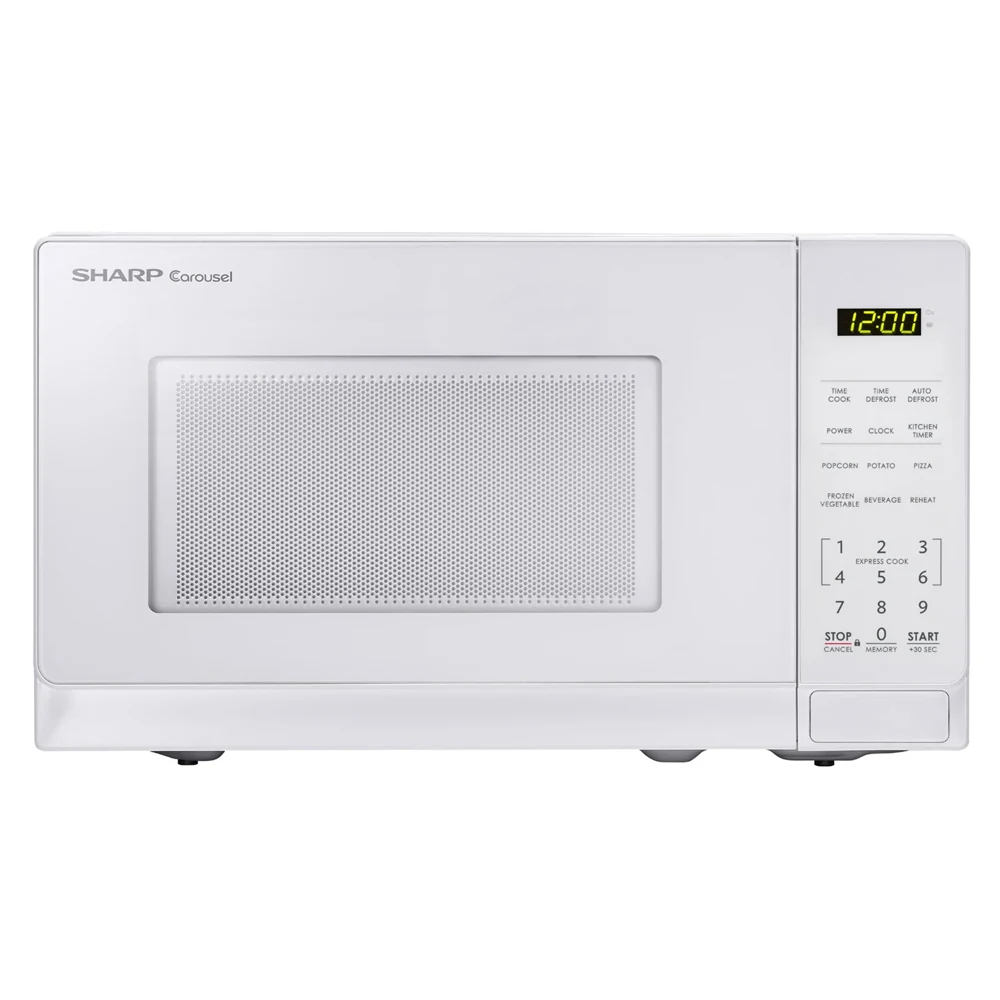
Your needs, this model
Does it fit your priorities?
Is this a sensible choice mainly for drinks and small portions?
Yes, provided your mugs and bowls fit. The compact body and timed controls suit that routine, while a 700-watt output means you must follow food-package directions appropriate to that power.
Explore this need in the finder →Does the Reheat button mean it has sensor reheating?
No. Sharp’s exact sheet marks sensor cooking and sensor reheat as unavailable. Choose a documented sensor model when automatic sensor reheating is essential.
Explore this need in the finder →How much counter space must I leave around it?
The body is 17.3 inches wide,12.8 deep and 10.2 high. The mirrored exact manual calls for four inches at each side, at the back and above; door access, cord and a safe landing area need additional checks.
Explore this need in the finder →The Sharp SMC0710BW is a compact white microwave for small portions, mugs and limited countertop space. Its 700-watt output and 10-inch rotating tray are the key compromises to accept. Choose it when the dishes you really use fit and simple timed reheating is enough; choose a larger model when broad plates, high-output package directions or sensor reheating drive the purchase.
Start with the small-space problem it can solve
A small microwave is valuable when it leaves enough counter free to prepare food, rather than simply because its capacity number is lower. Sharp's exact specification sheet gives a 17.3-inch-wide, 12.8-inch-deep, 10.2-inch-high body. It identifies a 0.7-cubic-foot cavity, a white finish and a 10-inch removable glass turntable. Those figures make it a useful candidate for a modest reheating station, but they do not mean it can operate in any opening of that size.
Think about the whole routine. Where will the open door go? Can you set down a hot drink beside the oven? Will you still have a usable food-preparation area? A compact appliance can be the better choice for one person or a couple even in a larger kitchen, provided it serves their cookware. Household size alone is not a reliable measure of how much microwave space you need.
The turntable is the more honest dish-fit check
A 10-inch tray should prompt a real measurement of your dinnerware. Your plate's rim, not the circle stamped on its base, determines the width you must accommodate. A tall bowl adds a different problem: enough height above the lid and enough room to get a hand safely around it. A rectangular lunch container can fit at one angle yet touch a wall as it turns.
Do that check before accepting a generic claim that a compact microwave fits a full-size plate. Dinner plates vary, and a rounded nominal size is not a promise about every piece of crockery. If you would have to transfer each meal into a smaller dish, the lost convenience may outweigh the saved counter space. If your normal bowl fits easily, a larger empty cavity adds little to the daily result.
Seven hundred watts changes your expectations
Sharp separately lists 700 watts of microwave output and 1,050 watts of input for this model. Output describes the cooking rating; input is the electrical draw specified by the appliance. They should not be swapped when reading a package or considering the power supply.
As a buying judgment, the lower output makes more sense for someone willing to learn a familiar routine than for someone who wants every meal instruction to match a higher-powered reference oven. Check the wattage range printed on food packaging and follow any supplied adjustment instructions. Do not assume a single conversion formula will reproduce every result: portion shape, starting condition and the food itself can change what happens. A small oven is not a promise of low total energy use for every meal simply because its output figure is lower.
A reheat button is not proof of a sensor
The official SMC0710BW page emphasizes timed conveniences, defrosting, a time-extension key and selected express intervals. The exact specification sheet lists automatic cooking buttons but marks sensor cooking and sensor reheat with dashes. We therefore do not treat this model as a sensor-reheat match.
That is not a reason to reject it if you already know the small tasks you want to do. Entering a familiar interval can be easier than choosing a food category. It is a reason to look elsewhere if your main request is an oven that estimates a starting time for constantly changing plated leftovers. More presets and actual humidity-sensor assistance are different benefits.
How it responds to common questionnaire priorities
“I mainly warm drinks and small portions.” This is the strongest fit, subject to your mug or bowl fitting comfortably. The compact body is a practical advantage when the microwave shares a small worktop with food preparation.
“I regularly heat wide dinner plates or family dishes.” Measure those items before shortlisting. If rotation is tight or two portions would require repeated transfers, more usable dish space is likely to matter more than the smaller case.
“Automatic sensor reheating is essential.” This is not the appropriate recommendation. Choose a model with exact sensor documentation instead of treating the word “reheat” on a button as equivalent.
“I need a quiet bedroom-adjacent setup.” The cited sources do not establish a switchable mute setting or a measured noise level. Button tones, fan noise, the door and a rotating dish are separate sound sources. Do not assume a small body makes an appliance quiet.
Placement, controls and ownership
The documented interface is touch control, with a clock, timer and a control lock. That does not establish a particular child-resistant door-release mechanism, and it is not evidence that a person with limited vision or hand strength will find it easy to use. Check the actual panel and door arrangement against the user who will operate it.
The exact-model installation instructions, preserved in a manual archive, call for four inches at the top, sides and rear. Include those gaps as well as door access when planning an open-counter location. No compatible trim kit has been established here, so the case dimensions must not be used to approve a tight cabinet. For an open-box or earlier offer, make sure the glass tray and support are supplied and correctly match the model.
Our recommendation is straightforward: keep the SMC0710BW on the list when saving counter space and heating modest servings are the real goals. Move to a larger or sensor-equipped model when your food and cookware demand it. A small microwave is a good purchase when it removes friction from the routine, not when it forces the routine to accommodate the appliance.
Key details at a glance
| Nominal cavity | 0.7 cu. ft. |
|---|---|
| Cooking output | 700 W |
| Turntable diameter | 10 in |
| Sensor reheating | Not supported in reviewed instructions |
| Body W × D × H | 17.3 × 12.8 × 10.2 in; ventilation additional |
Facts apply to the reviewed model and document edition. Read the relevant section for generation differences and installation conditions.
Sources for this assessment
Compare it with your other choices
Use your needs to find alternatives and understand the tradeoffs.