
Your needs, this model
Does it fit your priorities?
Can it handle reheating and small oven dishes in one place?
Its documented microwave, convection and combination modes make that a relevant use. Decide which oven tasks you would repeat, and check compatible cookware and the substantial operating space before paying for the extra modes.
Explore this need in the finder →Can I turn off the beeps?
The exact manual includes audible-signal elimination. This silences the signals rather than the cooling fan or other mechanical sounds, including fan operation after hot oven modes.
Explore this need in the finder →Will a large pan fit the tray?
Confirm the actual unit. Sharp’s US page lists 14.1 inches and its Canadian page 15.4 inches; we do not select the larger number as a guaranteed fit. Handles, rotation and cookware suitability still matter.
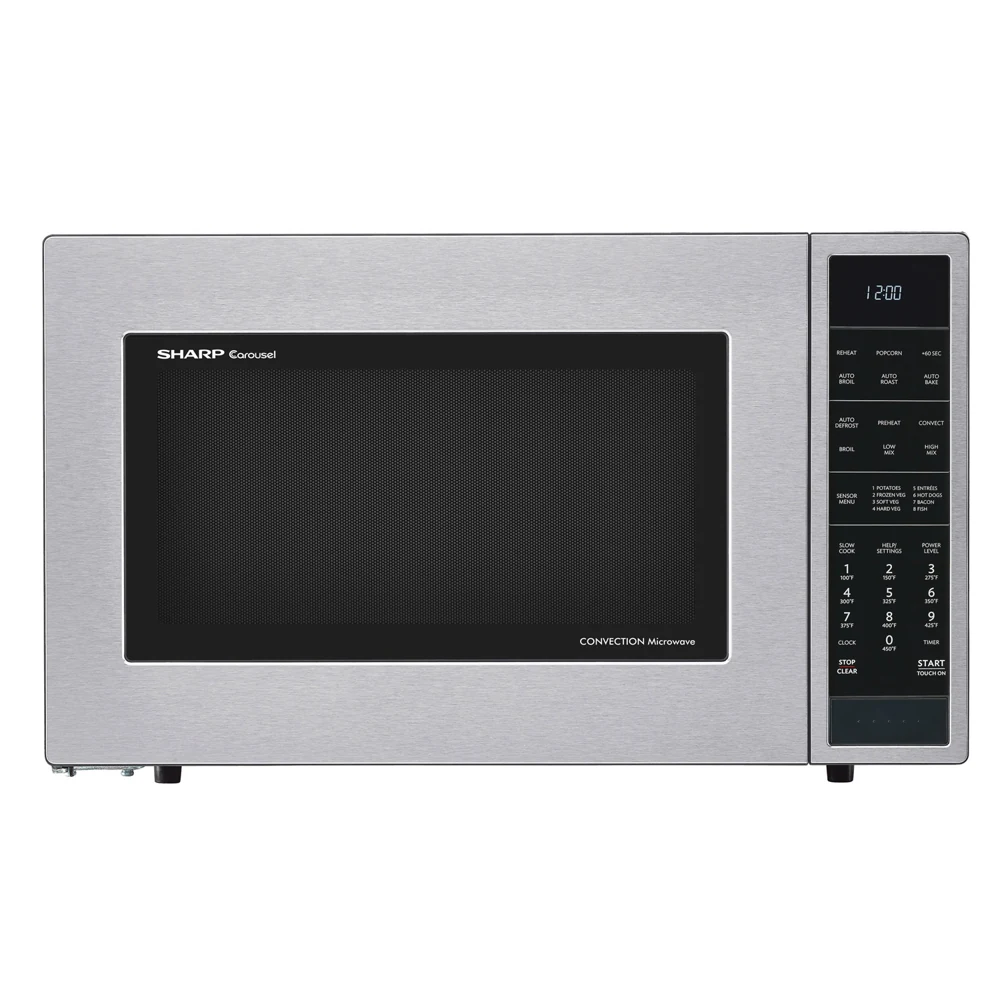
Explore this need in the finder →The Sharp SMC1585BS is an earlier convection-microwave combination for a household that wants both reheating and occasional oven cooking in one position. It is more interesting as a small-oven alternative than as a compact microwave. Sharp's US page now marks it discontinued, and the US and Canadian pages disagree about tray diameter. Compare a specific offer carefully, especially for cabinet replacement or an unusually large dish.
The useful difference is a second cooking method
A standard microwave is convenient for reheating, but it does not provide the same cooking method as an oven. The SMC1585BS adds convection, with automatic roasting, baking and broiling programs described on Sharp's exact US product page. It also documents sensor assistance for microwave tasks. That makes it relevant when one countertop position must serve both everyday reheating and small oven dishes.
Ask what you would actually bake or brown. If you already use a conventional oven efficiently for those tasks, an additional cooking mode may add a learning curve without saving much work. If heating the main oven for a small dish is the irritation you want to solve, a combination appliance deserves a closer comparison. Its value lies in a repeated job, not the longest list of modes.
Microwave power and oven power are different figures
The Sharp manual hosted by its Canadian division includes a US electrical rating and identifies 900 watts of microwave output separately from a 1,450-watt convection heater. It describes a 1.5-cubic-foot cavity and a body 24⅝ inches wide, 19 deep and 14⅞ high. The manual calls for at least two inches at the top, sides and rear for countertop airflow.
For the buyer, those figures explain why the model should not be chosen as a tiny microwave that happens to bake. Its body occupies a meaningful area, and the extra mode does not make its microwave output equivalent to a 1,200-watt oven. If fast reheating is your only priority, compare a microwave-only alternative on the same dishes and available space. More cooking methods do not automatically mean a better appliance for that routine.
Dish fit needs a direct check on this model
The US page identifies a 14.1-inch ceramic Carousel tray, while the Canadian exact-model page lists 15.4 inches. We retain that disagreement rather than selecting the larger value as a benefit. A close-fitting pan needs confirmation against the actual unit and supplied accessory, especially when comparing a regional or older offer.
Different cooking modes also make cookware choice more important. A container suitable for microwave reheating is not automatically appropriate for a hot convection cavity, and an oven pan cannot automatically be used in a mode that includes microwave energy. Keep a small set of dishes whose suitability you understand for each mode. Follow the model's utensil and rack instructions rather than guessing from the material alone.
Cabinet replacement requires the kit, not just the opening
Sharp's US trim-kit table pairs SMC1585BS with RK94S27F and RK94S30F. These are separate accessories. The exact oven code, kit, cutout, support and installation instructions must agree before a built-in recommendation is justified.
This is particularly important when an old microwave is already installed behind a matching-looking frame. A nominal 27- or 30-inch trim width does not prove that the internal ducting or attachment points suit another oven. Compare the existing installation's documents with the new purchase before removing the old appliance. If the correct kit cannot be obtained or the opening cannot comply, a visually similar product is not a direct replacement.
What your questionnaire answers mean here
“I want microwaving plus small-batch baking or browning.” This is the appropriate reason to consider the SMC1585BS. The tradeoff is a wider body, more mode-specific decisions and a purchase that now involves an earlier model.
“I only want a quick way to reheat lunch.” The combination design may be unnecessary. A microwave-only model can be simpler to compare and place. Judge the appliance on the task you do every day rather than a cooking mode you might use once.
“I want to disable the beeps.” The cited manual includes audible-signal elimination. That is a documented convenience, but it does not silence the fan or moving parts. The same manual explains cooling-fan operation after heated-oven modes, so muted signals must not be presented as silent operation.
“I need a guaranteed fit for a large pan.” The conflicting published tray sizes mean this needs physical confirmation. A supported pan may also have handles or height requirements that tray diameter alone cannot settle.
Is an earlier offer worth considering?
The discontinued status does not tell you whether any individual seller has stock, what condition it is in, or whether a particular warranty applies. Confirm those details for the actual offer, along with the supplied racks, tray and support. Compare the total cost with a documented newer alternative, especially if a trim kit or replacement accessory must be purchased separately.
Our judgment is that the SMC1585BS remains a useful reference for a genuine two-method cooking requirement or an exact installed replacement. It is less convincing as a casual upgrade from a basic microwave. The practical gains must justify both its operating space and the care needed to confirm a specific earlier unit. Decide which oven task it will take over, then check the intended cookware and installation before committing to an offer.
Key details at a glance
| Nominal cavity | 1.5 cu. ft. |
|---|---|
| Cooking output | 900 W |
| Sensor reheating | Documented |
| Alert mute setting | Documented |
| Approved trim-kit route | Documented |
| Body W × D × H | 24.625 × 19 × 14.875 in; ventilation additional |
Facts apply to the reviewed model and document edition. Read the relevant section for generation differences and installation conditions.
Sources for this assessment
- https://shop.sharpusa.com/1-5-cu-ft-900w-sharp-stainless-steel-carousel-convection-microwave-oven-smc1585bs/
- https://sharp.ca/uploads/product_downloads/SMC1585BS_OM.pdf
- https://sharp.ca/en/product/home-cooking-smc1585bs/
- https://files.sharpusa.com/Downloads/ForHome/HomeAppliances/MicrowaveOvens/TrimKits/TrimKits_TwoPages_12_16_19.pdf
Compare it with your other choices
Use your needs to find alternatives and understand the tradeoffs.