
Your needs, this model
Does it fit your priorities?
Will it suit wide dinner plates and changing portions of leftovers?
The documented 15-inch tray and sensor reheat make it a relevant shortlist choice. Confirm that your plate, handles and cover pass through the opening and rotate freely; tray diameter alone is not a maximum-dish guarantee.
Explore this need in the finder →Can I put it into an existing microwave cabinet?
Only after checking the exact installation. Sharp names RK49S27F and RK49S30F for this model, but the actual opening, support, electrical access and kit instructions must agree. An old frame from a different oven is not enough.
Explore this need in the finder →Is it worth the space if I mostly warm drinks?
Usually the larger cavity has little practical benefit for a mug alone. Prioritize a smaller operating footprint unless another dish you regularly use needs this model’s width.
Explore this need in the finder →The Sharp SMC1842CS is worth considering when the dish you actually use is too broad for a compact microwave, and you want sensor reheating without adding convection cooking. Its 15-inch turntable and optional built-in installation route are the useful distinctions. The compromise is a substantial countertop footprint: this is a microwave to measure for carefully, rather than choose from the 1.8-cubic-foot label alone.
Where the larger cavity makes sense
A household that reheats on broad dinner plates has a different problem from someone warming coffee in a mug. A mug may fit almost anything; a plate with raised edges, or a handled serving dish, can make a nominally roomy oven awkward. Sharp documents a 15-inch removable glass turntable for the SMC1842CS. That is a useful starting point for measuring your cookware, although it is not a guarantee that every 15-inch object will pass through the door and rotate freely.
The strongest reason to choose this model is consequently an existing piece of cookware. Measure its widest dimension, including handles, and think about how you will lift it out when hot. A family-size bowl that needs two oven mitts can require more usable room than its bare diameter suggests. Buying extra cavity volume for a dish you regularly use is sensible; buying it merely because the number looks generous can waste counter space.
Sensor reheating is a convenience, not a cooking verdict
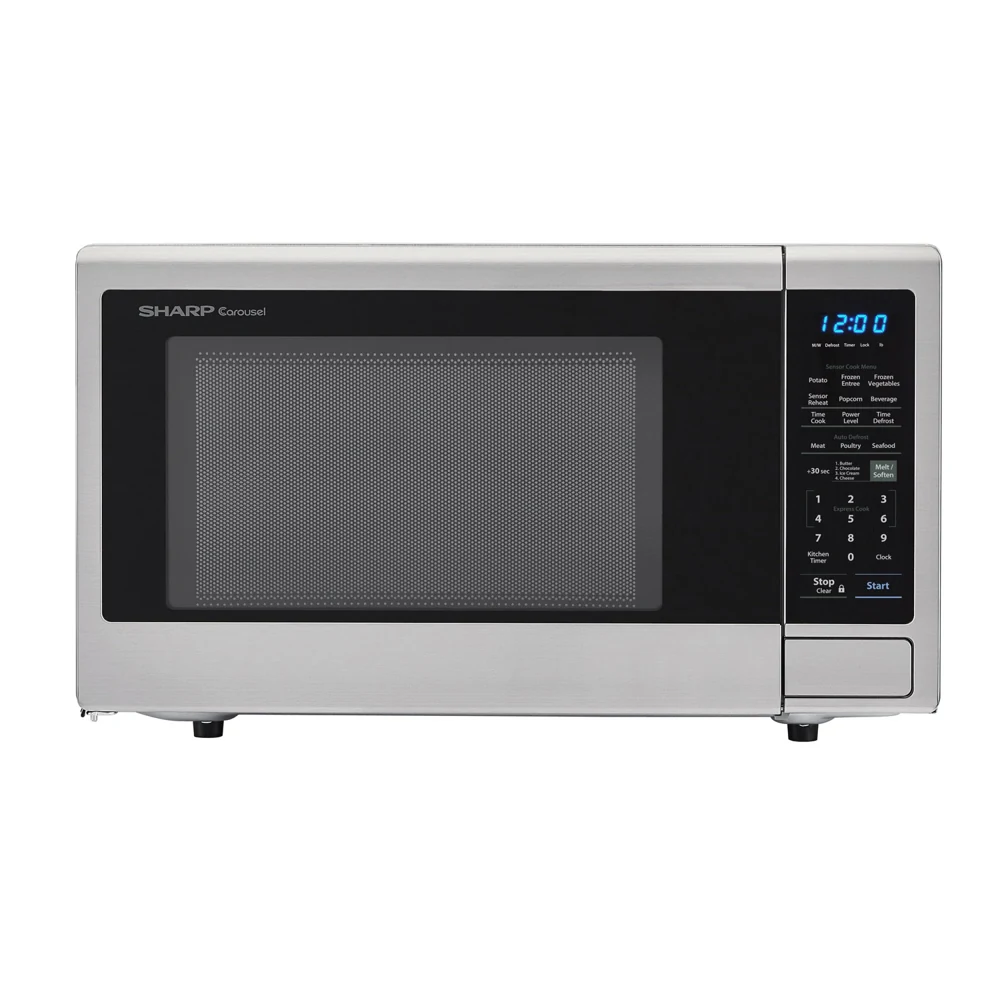
Sharp's exact-model page confirms sensor cooking and reheating, plus an instant-start time extension and softening functions. These are relevant if the amount of yesterday's dinner changes from day to day and you dislike choosing an initial time from scratch. They are less compelling if your routine is a fixed mug, a familiar quantity of oatmeal, and the same short sequence every morning.
Our recommendation is to treat a sensor as help with the first decision. You still decide whether the food needs stirring, whether a thick center is ready, and whether another brief interval is appropriate. Different foods sharing one plate can need different treatment. A sensor button does not turn a mixed plate into a uniformly behaving ingredient, nor does it provide independent evidence that this oven heats more evenly than competitors.
What the size and power figures mean together
The Sharp specification sheet lists 1,100 watts of microwave output, ten cooking power settings, and a body measuring 23.2 inches wide, 18.9 deep, and 13.3 high. It describes touch controls, time and weight defrost, and a control lock. These figures belong to SMC1842CS; a retailer's rounded “24-inch” description should not replace the manufacturer's dimensions.
The practical question is whether you can keep a useful working area beside it. Mark the body on the counter with removable tape, then allow the ventilation space required by the installation instructions and the sweep of the open door. Picture placing a hot bowl down safely without reaching across another appliance. If the microwave consumes the only preparation area, a smaller model with fewer headline features may be the better household fit.
Countertop placement and cabinet installation are separate decisions
The SMC1842CS has a documented trim-kit route, which matters to an owner replacing an installed microwave. Sharp's current trim-kit compatibility sheet names RK49S27F and RK49S30F for this model. The product page also links those kits. A trim kit supplies an installation system, not just a decorative border.
Do not select a kit by its nominal 27- or 30-inch size alone. The cabinet opening, airflow path, support and electrical access must match the exact kit instructions. An existing frame from a different Sharp oven is not automatically reusable. If your questionnaire answer is “I need a cabinet replacement,” the appropriate next step is to compare the oven's nameplate and the actual kit manual with the opening, rather than give this model a pass simply because it says built-in capable.
How it fits your questionnaire answers
“I reheat substantial plated meals and want fewer timing decisions.” This is the most convincing match: a broad tray and confirmed sensor reheating address those needs directly. You should still confirm that your particular plate clears the door and the cavity throughout a full turn.
“I want one appliance for baking and crisping.” Choose another type. The documented heating mode here is microwave cooking; the softening presets do not make it a convection oven. Paying for a larger microwave does not buy a different cooking method.
“My kitchen is small and I mostly warm drinks.” The capacity advantage is unlikely to justify the space unless a specific dish demands it. A compact footprint should take priority over a long preset list in that situation.
“I need a completely silent microwave or a particular door-release arrangement.” The evidence reviewed does not establish a mute function or a newer two-step child-resistant door release. A control lock is not proof of either. Check the actual unit and its supplied instructions before treating those as essential matches.
Our buying judgment
Shortlist the SMC1842CS for roomy everyday reheating, especially when its exact installation compatibility solves an existing kitchen problem. Its tradeoff is the space that must remain available around a large body. Before ordering any offer, verify SMC1842CS on the listing and nameplate, confirm condition and included accessories, and compare the total purchase with smaller alternatives that fit your own dishes. A worthwhile upgrade should make the cookware and meal routine easier, while leaving a practical place to work.
Key details at a glance
| Nominal cavity | 1.8 cu. ft. |
|---|---|
| Cooking output | 1100 W |
| Turntable diameter | 15 in |
| Sensor reheating | Documented |
| Approved trim-kit route | Documented |
| Body W × D × H | 23.2 × 18.9 × 13.3 in; ventilation additional |
Facts apply to the reviewed model and document edition. Read the relevant section for generation differences and installation conditions.
Sources for this assessment
- https://shop.sharpusa.com/1-8-cu-ft-1100w-sharp-stainless-steel-countertop-microwave-oven-smc1842cs/
- https://assets.ajmadison.com/ajmadison/itemdocs/SMC1842CS_Spec_Sheet.pdf
- https://files.sharpusa.com/Downloads/ForHome/HomeAppliances/MicrowaveOvens/TrimKits/TrimKits_TwoPages_12_16_19.pdf
- https://content.abt.com/documents/139716/OperatingManual-SMC1843CM-1.pdf
Compare it with your other choices
Use your needs to find alternatives and understand the tradeoffs.