
Your needs, this model
Does it fit your priorities?
Does it help when I change the size of my leftovers?
Its sensor programs detect steam before displaying remaining cooking time. Use the food-specific covering and sensing instructions; a mixed thick meal still needs checking.
Explore this need in the finder →Is this the same as the ML-EM45PIT?
No. The reviewed P(BS) manual specifies 1,200 W output and a shallower 17.91-inch body. Do not transfer the PIT’s 1,250 W or inverter specification to this model.
Explore this need in the finder →Is it a sensible compact-kitchen choice?
Only if the full counter footprint and ventilation fit comfortably. For a single mug or small personal portion, its larger cavity may consume preparation space you would value more.
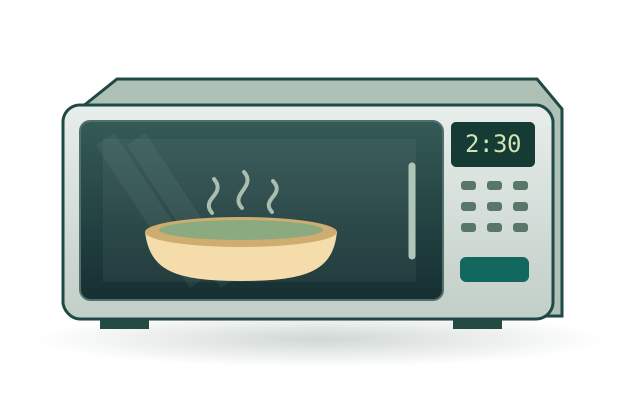
Explore this need in the finder →The Toshiba ML-EM45P(BS) is most relevant to someone reheating dinner plates and family portions who wants sensor cooking and a mute function without moving into an air-fryer combination oven. Its 1,200-watt output and roughly 1.6-cu.-ft. cavity are useful, but it is a larger counter commitment than its similar-looking compact Toshiba relatives.
A family-size option with a specific model identity
The letters matter here. ML-EM45P(BS) and ML-EM45PIT(BS) are separate models. An offer that drops the ending cannot establish which one you are buying. The exact P manual documents a 45-liter cavity, a 13.58-inch tray and 1,200-watt cooking output. It should not inherit the PIT's 1,250-watt specification or inverter claim. ML-EM45P(BS) specifications.
For a household heating a covered dinner plate or a larger bowl of leftovers, the practical advantage is room to arrange food in a relatively shallow layer. It is not a guarantee that a family casserole will fit. Measure its handles, lid and height, and allow the dish to turn without touching the cavity. “Family size” should describe your container, not just a marketing category.
Sensor cooking is the main reason to shortlist it
The reviewed manual's Sensor Cook chapter starts a supported menu without manually setting time, then displays remaining time after steam is detected. That is a meaningful convenience for someone who dislikes guessing a fresh reheating time for every portion. Toshiba's sensor operation chapter.
The sensible expectation is assistance, not a promise that every leftover needs no attention. A thick meal with several ingredients is different from a single uniform food. Read the food-category instructions, use the specified covering and check the result. If you routinely take the bowl out midway to stir, be aware that interrupting an initial sensing stage can interfere with the program. Manual power and timing remain valuable controls rather than a failure of automation.
Counter depth may decide between two similar Toshibas
The P manual gives an exterior of 21.77 inches wide, 17.91 deep and 12.87 high. Its nominal depth is shallower than the documented PIT body, but that difference is not permission to push either oven against surrounding furniture. Ventilation and safe door access have to be checked in the exact installation chapter.
Think about where the appliance will stand all day. A microwave can technically sit on a counter yet obstruct the only preparation space. Make a cardboard footprint and open the neighboring drawer and cabinet doors. Include a spot where you can put a hot plate down without reaching across the open microwave door. Those ordinary movements often reveal a poor fit more clearly than another comparison of cavity volumes.
Useful routines beyond full-power reheating
The operating contents cover custom defrost, softening and melting, saved procedures and two-section cooking. These are relevant if you alternate between thawing an ingredient and reheating a finished meal. A memory is most useful when the quantity is repeatable; it should not encourage you to run the same sequence regardless of how much food goes into the bowl. Exact-model operating manual.
The 1,200-watt output rating means packaged-food directions deserve a quick check. Start from the food maker's instructions for the stated wattage, then adjust carefully where needed. The separate 1,600-watt input figure describes electrical demand rather than power delivered to the food. Do not choose a circuit or extension arrangement from the cooking-output number.
Sound and turntable features answer different needs
A dedicated Mute Function chapter and a turntable-reset chapter are present in the reviewed manual. Muting is relevant to late-night snacks in a shared home. A returning tray position can help when a mug handle would otherwise finish pointing away from you. These conveniences should be evaluated separately: easier retrieval does not prove that a large container fits, and a muted buzzer does not make the fan silent.
The documented child lock concerns operation. It should not be substituted for evidence about a later mechanical door lock or treated as a promise that every retail revision opens in the same way. If grip or a two-step opening sequence matters, ask for the exact unit's controls and instructions rather than judging from a family photograph.
The compromises are size and evidence boundaries
This is not the natural choice for a narrow dorm-room shelf or a person who only warms one mug. Space consumed by capacity you never use is still space lost. It also does not meet an essential inverter requirement on the evidence reviewed here; the similar PIT name is not a reason to mark that box.
There is no established exact-model trim-kit route in the reviewed record. Treat it as a countertop selection. If a built-in appearance is your priority, start with an oven and installation kit that the manufacturer explicitly pairs, then verify the opening and ventilation drawings. A decorative surround cannot turn a freestanding oven into an approved installation.
Which answers should bring it forward?
Shortlist this model when your questionnaire answers emphasize dinner-plate meals, sensor help and switchable sounds, with enough clear counter space for a full-size oven. Prefer another option when your central requirement is inverter control, a particularly small footprint, a confirmed cabinet installation or crisping and baking.
When comparing offers, retain the full P(BS) model code. Check the supplied edition, actual dimensions, return terms and included tray. The right decision is a product that fits your routine and installation, rather than the seller whose title happens to contain the largest number of features.
Key details at a glance
| Nominal cavity | 1.5891600024669865 cu. ft. |
|---|---|
| Cooking output | 1200 W |
| Turntable diameter | 13.58 in |
| Sensor reheating | Documented |
| Alert mute setting | Documented |
| Body W × D × H | 21.77 × 17.91 × 12.87 in; ventilation additional |
Facts apply to the reviewed model and document edition. Read the relevant section for generation differences and installation conditions.
Sources for this assessment
Compare it with your other choices
Use your needs to find alternatives and understand the tradeoffs.